

A complete cybersecurity audit checklist verifies governance, asset inventory, access controls with MFA, patching, encryption, backups, logging, and a tested incident response plan. Map each item to the NIST Cybersecurity Framework 2.0 and CISA’s yes/no goals, then set your testing cadence from the FTC Safeguards Rule. Pick your scope and start an asset inventory this week, or ask us to run it with you.
TL;DR:
- Treat NIST CSF 2.0 as an outcomes framework, not a prebuilt checklist; tailor controls to your environment and attach evidence to every pass.
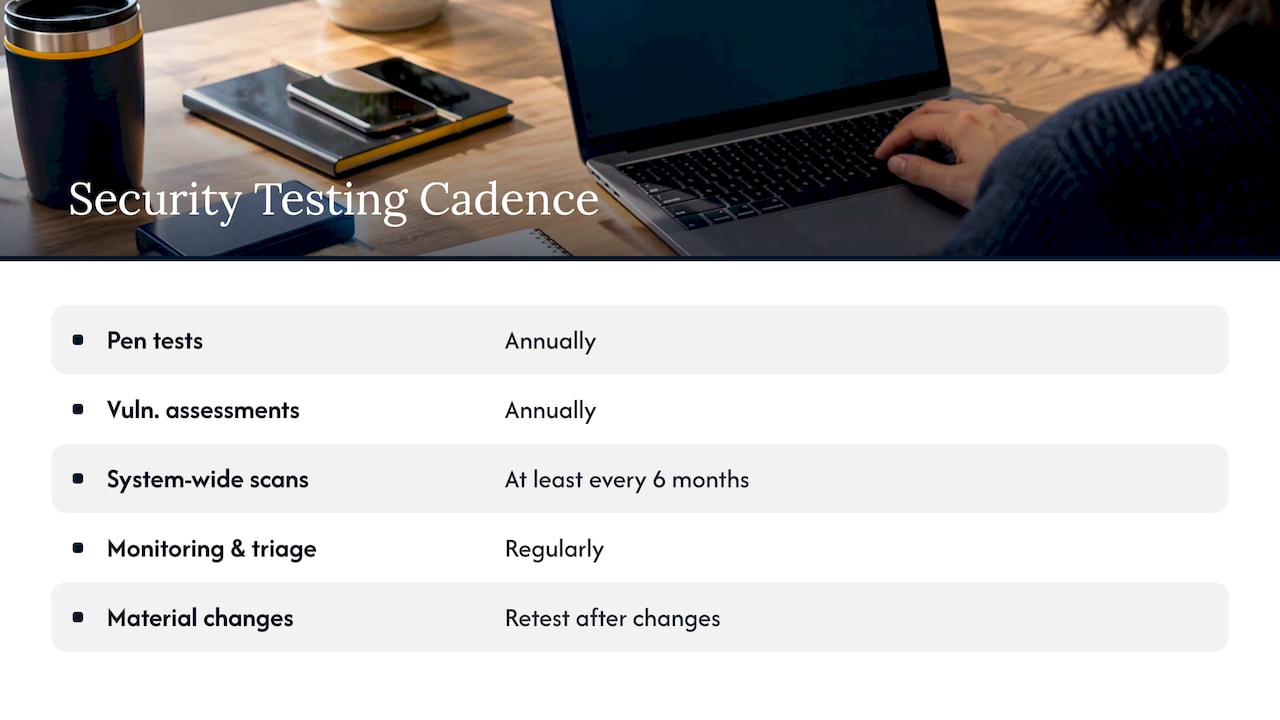
- Without continuous monitoring, the FTC Safeguards Rule requires annual penetration tests and vulnerability assessments, with systemwide scans at least every six months.
- Sample access reviews against HR departure records, then test removals; comparing former staff with active accounts exposes deprovisioning gaps faster than reviewing IT rosters alone.
- Rank findings by asset criticality, impact, and exploitability; prioritize MFA, backups, and an incident response plan, then give each fix an owner and target date.
Table of Contents
- What should a cybersecurity audit checklist cover by function?
- How do you run the audit from scope to remediation?
- Which controls should you verify, and what evidence proves them?
- How often should you test your security controls?
- How do you prioritize findings with a risk-based approach?
- Why does a security audit have to stay alive?
- Need help running this checklist?
- FAQ
- Sources
What should a cybersecurity audit checklist cover by function?
The six functions of NIST CSF 2.0 (Govern, Identify, Protect, Detect, Respond, Recover) give you a structure auditors recognize. CISA’s Cybersecurity Performance Goals map specific controls to those same functions, so one checklist can serve both. Tick each item below as pass, fail, or not applicable, and attach evidence to every pass.
Govern
- A documented security program that fits your size and complexity
- A named Qualified Individual who owns the program
- Regular reporting to the board or a senior officer
- Written security requirements for vendors and service providers
Identify
- A complete asset inventory covering laptops, servers, cloud services, printers, and network gear
- Data and asset classification, so you know what matters most
- A risk register with an owner for each risk
- Third-party validation items, such as vendor questionnaires or attestations
Protect
- MFA on remote and privileged access
- Least-privilege access and documented configuration baselines
- Patch management with a defined schedule
- Encryption at rest and in transit, plus tested backups
- Secure configurations for printers, copiers, and other office equipment, which often get skipped
Detect
- Centralized logging across servers, endpoints, and cloud accounts
- Alerting rules that someone actually reviews
- Named monitoring responsibilities, whether in-house or outsourced
- Verified log retention that matches your policy
Respond
- A written incident response plan
- Defined roles and a communications plan for staff, customers, and regulators
- Annual incident response drills
Recover
- Backup integrity checks
- Documented recovery playbooks for your critical systems
- Post-incident reviews that feed a plan of action and milestones (POA&M)
One caution from NIST: the CSF Core is not a prescriptive checklist. It describes outcomes, and you tailor the actions. Your checklist is the tailored version, so write it for your environment rather than copying one wholesale.
How do you run the audit from scope to remediation?
A checklist only helps when it sits inside a repeatable process. The workflow below works for a small IT team and for an internal audit department. If your business handles financial data, our FTC Safeguards Rule compliance guide explains how these steps support the regulation.
- Set the scope. Define the systems, business processes, and time frame, then choose your alignment: a NIST CSF profile or the CISA goals.
- Collect evidence. Gather inventories, policy documents, access rosters, configuration exports, log samples, backup logs, and training records.
- Test the controls. Run vulnerability scans, review sample configurations, test user entitlements, and send phishing simulations. Add a penetration test where your risk or regulations call for one.
- Rate the findings. Use a simple severity scale, such as critical, high, medium, and low, and define each level in writing before you start.
- Build the POA&M. Assign an owner, a target date, and a verification step to every finding.
- Verify the fixes. Retest remediated items and record the proof, not just a closed ticket.
Pro Tip: Sample access reviews from the HR termination list, not the IT user list. Comparing who left the company against who can still log in is the fastest way to find deprovisioning gaps.
Treat the audit as a living process. FTC guidance says to revisit it after material changes, such as adding cloud services, remote offices, or new suppliers, instead of filing it away once a year.
Which controls should you verify, and what evidence proves them?
Use these pass/fail checks as the basis for your audit worksheet. For each one, pull a sample rather than trusting a policy statement.
Patching
- Evidence of a patch management policy and automated updates
- An exception log for unsupported systems, each with a compensating control
Identity and access
- MFA enforced on all remote and privileged access, ideally phishing-resistant (our phishing-resistant authentication guide walks through the steps)
- Privilege separation between every day and administrator accounts
- Deprovisioning evidence for recent departures
- Role-based access, which NIST defines as a core access control concept auditors commonly verify
Endpoints and network
- Endpoint detection and response (EDR) status across all devices
- Device encryption on laptops and mobile devices
- Firewall rule samples and segmentation evidence
- No exposed services without compensating controls
- Default passwords changed on all hardware, with exceptions documented, as the CISA checklist recommends
Our endpoint hardening guide covers a 30 to 90 day rollout if this area has gaps.
Data and backups
- Data classification evidence
- Encryption at rest and in transit
- Backup schedules and records of test restores, since an untested backup is only a hope
- Disposal procedures, because FTC guidance treats data disposal as part of the security program lifecycle
Third-party management
- Vendor contracts with security clauses
- Vendor risk assessments on file
- A process for vendors to disclose vulnerabilities in their products
Training and awareness
- Training schedules and attendance records
- Phishing simulation results with follow-up for repeat clickers
If email is where your simulations fail most often, our email security checklist covers the Protect controls that reduce that exposure.
How often should you test your security controls?
Testing cadence is where audits most often fall short, because teams scan once and call it done. The FTC Safeguards Rule sets a floor you can defend.
Without continuous monitoring, the FTC Safeguards Rule requires annual penetration testing and vulnerability assessments, including system-wide scans at least every six months. Treat that as your minimum, not your target.
CISA and NIST add practical expectations on top of the regulation. The CISA goals are binary yes/no statements, which makes progress easy to measure and report. NIST’s small business guidance recommends tailored profiles to help organizations prioritize controls.
A practical cadence for a small or mid-sized environment should include regular monitoring and alert triage, patch reviews, vulnerability scans, penetration tests, and incident response exercises. Set the testing schedule to meet any applicable requirements, including the FTC Safeguards Rule.
Adjust upward for critical systems and anything exposed to the internet. Also retest after material changes, such as a new cloud platform or a merger, rather than waiting for the calendar.
How do you prioritize findings with a risk-based approach?
A first audit can produce dozens of findings. Funding all of them at once is unrealistic, so rank them.
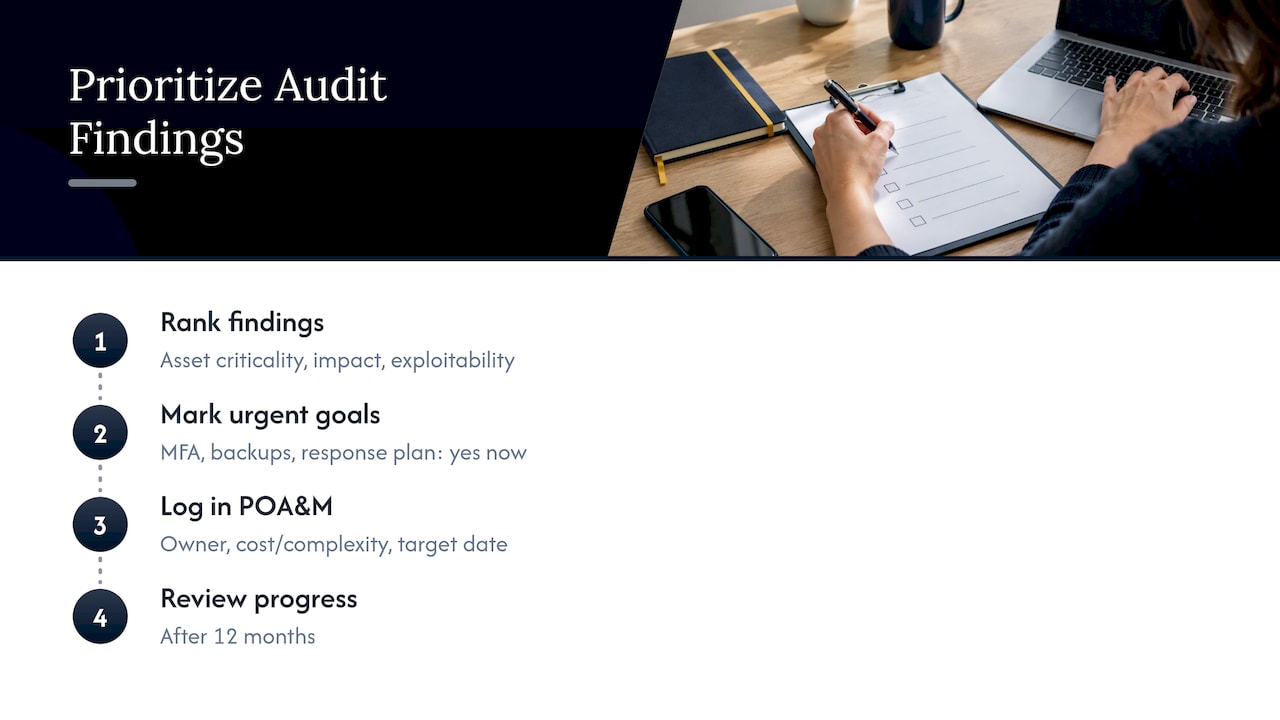
Start with asset criticality from your inventory. A missing patch on a public-facing server holding customer records outranks the same gap on a spare workstation. Rate each finding on impact and on how easily an attacker could exploit it.
Then use the CISA goals as binary markers. Decide which must be “yes” now, such as MFA, backups, and a written incident response plan, and which can be staged over time. The CISA worksheet helps you rank gaps by cost, complexity, and impact.
Finally, record everything in a POA&M with an owner, an estimated cost or complexity, and a target date. The CISA worksheet recommends reviewing progress after 12 months. Our guide to fixing three NIST CSF outcomes in 90 days shows one way to stage that work.
Why does a security audit have to stay alive?
An audit that sits in a folder is a snapshot of a company that no longer exists. New software, new suppliers, and staff changes all shift your risk within weeks. The checklist earns its value when someone owns it, updates it, and feeds findings back into the next cycle.
That is the part small teams struggle to sustain, and it is where an ongoing partner makes the biggest difference: someone keeping the inventory current, watching the alerts, and holding the remediation schedule.
— Jeffrey
Need help running this checklist?
We operate as an outsourced IT department. Our cybersecurity and managed IT services include 24/7 monitoring and a USA-based help desk with an average response under 12 minutes. Contact us for an assessment.

FAQ
What is included in a cybersecurity audit checklist?
A solid checklist covers governance, asset inventory, access controls with MFA, patching, encryption, backups, logging, and an incident response plan. It also records the testing cadence and the evidence behind each pass. NIST’s six functions give a clean way to organize all of it.
How often should a business run a cybersecurity audit?
Run a full audit regularly and again after major changes, such as new cloud services or suppliers. FTC guidance treats the audit as a living process rather than a once-a-year event. Between audits, keep monitoring and patch reviews on a regular schedule.
Is the NIST Cybersecurity Framework a checklist?
No. NIST states that the Core outcomes are not a prescriptive checklist, so you tailor the actions to your environment. A practical audit checklist turns those outcomes into specific, testable items.
Is there a checklist built for small organizations?
Yes. FINRA publishes a Small Firm Cybersecurity Checklist that follows the NIST functions and supports small firms building a program. CISA’s goals also work as a manageable self-assessment for smaller teams.
Sources
- FTC Safeguards Rule: What Your Business Needs to Know | Federal Trade Commission
- NIST Cybersecurity Framework 2.0: Small Business Quick-Start Guide
- Cybersecurity Performance Goals (CPGs) | CISA