

SaaS security controls are the policies, configurations, and tools your business uses to protect data and user identities in cloud-hosted applications managed by a third-party vendor. The vendor secures the underlying infrastructure. You are responsible for configuration, identity, and data governance. That split is the shared responsibility model, and misunderstanding it is where most Ohio SMBs run into trouble.
The risks are real and specific. Misconfigurations, credential misuse, and over-permissive third-party integrations are the most common causes of SaaS incidents, not platform-level exploits. Regulatory pressure adds another layer: SOC 2 is the default US compliance standard for SaaS, HIPAA governs protected health information, and GDPR applies whenever you process personal data from EU residents.
The core controls every IT decision-maker needs in place:
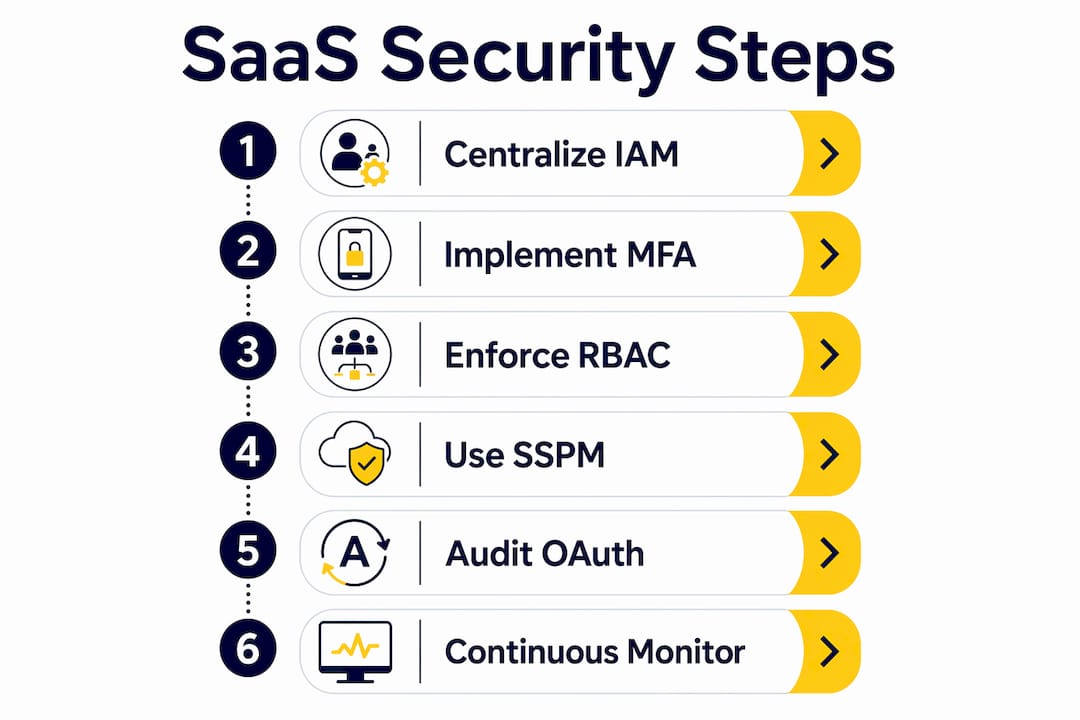
- Multi-factor authentication (MFA): Enforced for all users and admin accounts, centrally through your identity provider
- Role-based access control (RBAC): Permissions tied to job function, reviewed regularly, with least privilege as the default
- SaaS Security Posture Management (SSPM): Continuous monitoring tools that surface misconfigurations, excessive permissions, and risky OAuth connections
- Identity and access management (IAM): A single identity provider (IdP) with conditional access policies applied across all SaaS apps
- Data loss prevention (DLP): Policies tied to data classification, blocking or flagging inappropriate sharing and downloads
- Compliance mapping: Controls aligned to SOC 2, HIPAA, or GDPR so one audit process satisfies multiple frameworks
Continuous monitoring is not optional. SaaS environments drift. Permissions accumulate. Integrations go unreviewed. Treating SaaS security as a one-time setup is the fastest path to a preventable breach.
What SaaS security controls should you implement first?
Start with identity. Centralized IAM and SSPM tools close the visibility gap faster than any other control, especially when shadow SaaS adoption has already spread across your organization. Without a single IdP, you end up with dozens of separate access systems, no unified view of who has access to what, and former employees who can still log in months after they leave.

MFA and RBAC work together. MFA stops credential-based attacks at the door. RBAC limits the damage if an account is compromised, because a support engineer with least-privilege access cannot reach production databases even with valid credentials. Both controls also satisfy requirements across SOC 2, HIPAA, and NIST SP 800-53 simultaneously, which is why mapping controls across frameworks early reduces long-term audit costs.
SSPM tools give you continuous monitoring of configuration drift, OAuth app permissions, and sharing settings across your entire SaaS portfolio. They surface the problems that manual reviews miss: an admin account without MFA, a file-sharing setting left open to anyone with a link, a third-party integration with scopes far broader than the app actually needs.
Pro Tip: Run a quarterly audit of every OAuth-connected application in your SaaS environment. Revoke permissions for any app that has not been actively used in 90 days. Permission creep from forgotten integrations is one of the most common and easily preventable SaaS risks.
SOC 2 Type II deserves a specific mention. Type I confirms your controls are designed correctly at a point in time. Type II confirms they operated effectively over a 6–12-month period. Enterprise buyers almost always require Type II because it shows operational consistency, not just good intentions on audit day. If you are selling to larger customers or regulated industries, Type II is the target.
Key controls to layer in after identity:
- Data classification: Know what sensitive data you hold and where it lives before writing DLP rules. Rules without classification are too broad to catch real leaks.
- OAuth app auditing: Inventory every third-party integration. Revoke unused apps. Check that active apps use only the minimum required scopes.
- Encryption verification: Confirm sensitive fields are covered at rest and in transit. Most SaaS vendors provide TLS and platform-managed keys, but you still need to verify the configuration.
- Audit log retention: Enable logs for all critical systems and configure alerts for suspicious activity like failed logins or unusual data access patterns.
- Incident response planning: Build a SaaS-specific playbook covering isolation, vendor notification, and internal stakeholder communication.
Which Ohio providers can help you manage SaaS security controls?
Three providers serve Ohio businesses with meaningfully different specializations. The right fit depends on your compliance requirements, technical complexity, and how much you want to manage in-house.
| Provider | Services and specialization | Compliance expertise | Local presence | Certifications and awards | Support model | Rating |
|---|---|---|---|---|---|---|
| Mavericks Office Solutions | Full outsourced IT and cybersecurity for SMBs, including 24/7 monitoring, IAM, and SaaS security | SOC 2, HIPAA, GDPR alignment for SMBs | Ohio-based, local help desk, under 12-minute average response | — | 24/7 monitoring, USA-based help desk, no offshore routing | 5★ (6 reviews) |
| Securafy Inc. | MSP and MSSP services: penetration testing, compliance as a service, vCISO, dark web monitoring, SASE | NIST, CJIS, HIPAA, GLBA, PCI-DSS, SOC 2, FTC Safeguards Rule | Serves Ohio and surrounding region | Soteria Award: Most Trusted MSP in North America 2024 | Managed security with compliance-as-a-service model | 5★ (6 reviews) |
| Keyfactor | Trust infrastructure, PKI, certificate automation, machine identity management | Regulated industries: financial services, energy, utilities | Ohio-based, serves Fortune 500 globally | — | Enterprise-grade, focused on cryptographic security programs | 5★ (3 reviews) |
Securafy Inc. is the strongest option for Ohio businesses that need documented compliance across multiple frameworks. Their 2024 Soteria Award for Most Trusted MSP in North America reflects a prevention-first approach, and their compliance-as-a-service model covers NIST, HIPAA, SOC 2, CJIS, and the FTC Safeguards Rule. Healthcare practices, law firms, and financial services companies in Ohio will find their industry-specific experience directly applicable.
Keyfactor operates at a different level of technical depth. Their focus is machine identity management and cryptographic infrastructure, which matters most when you are managing certificate lifecycles at scale, securing AI systems, or preparing for quantum-era threats. Fortune 500 companies and regulated industries are their primary audience.
Mavericksofficesolutions is the practical choice for Ohio SMBs that want a single provider handling IT, cybersecurity, and SaaS security without building an internal team. Their managed IT services include 24/7 monitoring and a USA-based help desk with an average response time under 12 minutes. For a small or mid-sized Ohio business that needs SaaS security controls implemented and maintained without the overhead of multiple vendors, that combination of local presence and broad service coverage is the clearest fit.
How do you choose the right SaaS security provider for your business?
The right provider depends on four factors: your compliance requirements, your internal IT capacity, your SaaS environment’s complexity, and your budget model.
Start with compliance. If you handle health information, HIPAA alignment is non-negotiable. If you process payment data, PCI-DSS applies. If you sell to enterprise buyers, SOC 2 Type II is likely a contract requirement. A provider that cannot demonstrate direct experience with your specific framework is a risk, not a solution.
Evaluate these criteria before signing any agreement:
- Service breadth: Does the provider cover IAM, SSPM, DLP, and compliance reporting, or only one piece?
- Certifications: Look for documented credentials in the frameworks your business must meet, not just general cybersecurity experience.
- Local support: Response time matters when something goes wrong. A USA-based help desk with a defined SLA is more reliable than offshore routing.
- Implementation timeline: Ask for a clear milestone plan. A realistic SaaS security deployment typically runs in phases: IAM and MFA first, then SSPM and DLP, then compliance documentation and audit readiness.
- Ongoing monitoring: Controls drift. Your provider should offer continuous monitoring and remediation, not just an annual review.
- Pricing model: Managed service contracts offer predictable monthly costs. Advisory or tool-based models may cost less upfront but require more internal effort to execute.
Ohio SMBs evaluating a cybersecurity plan for 2026 should also ask providers how they handle third-party integration audits and whether they include OAuth app reviews in their standard service scope. Many do not, and that gap is where permission creep quietly accumulates.
Mavericksofficesolutions handles SaaS security so you don’t have to
Running SaaS security controls in-house is a full-time job, and most Ohio SMBs do not have the internal staff to do it consistently. Mavericksofficesolutions functions as your outsourced IT department, covering managed cybersecurity, 24/7 monitoring, IAM implementation, and compliance support under one monthly agreement.
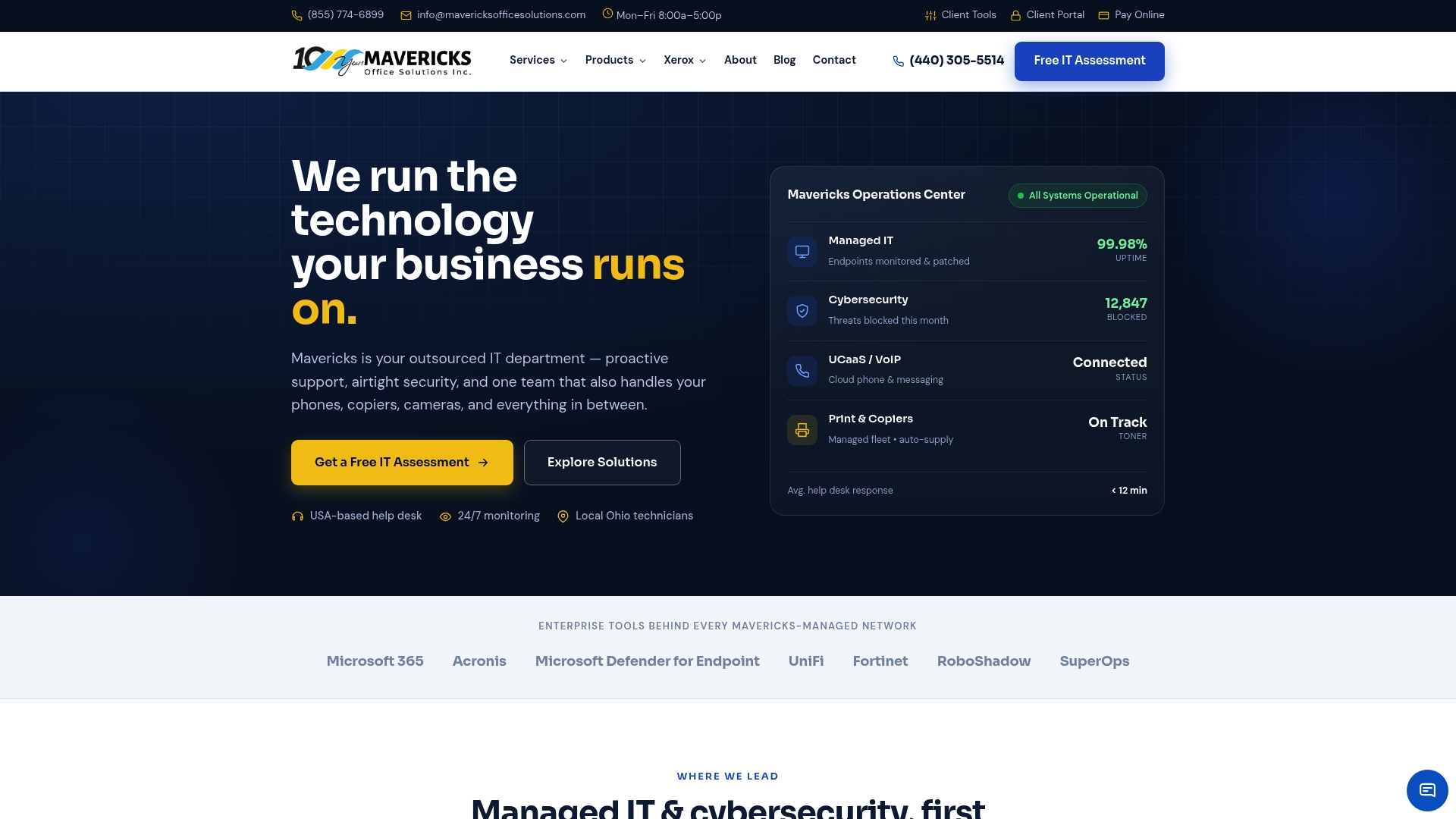
The difference from hiring a point-solution vendor is straightforward. You get a single provider managing your SaaS security posture alongside your broader IT environment, with a local Ohio help desk that picks up in under 12 minutes on average. No offshore call centers, no handoff between separate vendors, no gap between your security controls and your day-to-day IT operations. If you are ready to put a real SaaS security program in place without building an internal team, contact Mavericksofficesolutions to discuss what that looks like for your business.
Key Takeaways
Effective SaaS security requires continuous monitoring, centralized identity management, and compliance alignment across SOC 2, HIPAA, and GDPR, not a one-time configuration.
| Point | Details |
|---|---|
| Shared responsibility is your problem | The SaaS vendor secures infrastructure; you own configuration, identity, data classification, and compliance. |
| Start with IAM and MFA | Centralized identity management and MFA enforcement close the most common SaaS attack vectors first. |
| SSPM enables continuous control | SSPM tools surface configuration drift, excessive OAuth permissions, and risky integrations automatically. |
| Map controls across frameworks | One access review process can satisfy SOC 2, HIPAA, and NIST requirements simultaneously, reducing audit overhead. |
| Mavericksofficesolutions | Ohio SMBs get 24/7 SaaS security monitoring and managed IT support from a single local provider with under 12-minute response times. |