
Most small and mid-sized businesses pay between $125 and $450 per month to lease an office copier, with high-volume departments running past $600. The three biggest levers on that number are lease term, color capability, and monthly page volume. As a starting budget heuristic, plan on $125 to $350 per month for a typical office, then adjust up for color-heavy printing or down for a longer lease term.
TL;DR:
- Lease terms, color printing needs, and monthly page volume significantly influence costs, with high-volume and color-heavy printing raising monthly payments above $600.
- Refurbished copiers can reduce costs by 20 to 40 percent but require careful review of warranty and service terms, especially for light-volume offices.
- Differences in lease structure, service levels, and overage fees can cause identical quotes to vary by hundreds of dollars each month.
- Including bundled maintenance and supplies in a lease generally increases cost but simplifies budgeting, while separate charges for overages and end-of-lease fees can unexpectedly inflate expenses.
- For small offices, typical monthly payments range from $50 to $250, while high-volume departments easily exceed $600, emphasizing the importance of matching the machine to actual print volume.
Table of Contents
- Copier Lease Cost by Machine Class and Volume
- What Actually Moves Your Monthly Payment
- What’s Included in a Lease (and What Isn’t)
- Worked Examples: Matching Your Office to a Monthly Number
- Comparing Quotes and Negotiating Terms
- Ending a Lease Early or Buying Out the Balance
- How Mavericks Approaches Print Cost Control
- Get a Straight Answer on Your Own Copier Costs
- Sources
- FAQ
Copier Lease Cost by Machine Class and Volume
The range you land in depends almost entirely on what the machine needs to do, not just its brand or year. A desktop printer covering light overflow costs nothing like a departmental workhorse producing thousands of color pages a week.
Most business copiers lease for roughly $125 to $450 per month, with high-volume systems exceeding $600. Dealer pages and regional case studies show small-office leases often landing near $90 to $350 per month once color percentage and service inclusions are factored in. That variation isn’t dealers being inconsistent. It reflects real differences in speed, duty cycle, and how much color a business actually prints.

Refurbished and pre-owned equipment can undercut these ranges by 20 to 40 percent for businesses that don’t need the newest engine, though warranty and service terms need extra scrutiny before signing. If your volume is genuinely light, a refurbished or pre-owned copier is often the more sensible entry point than a new workgroup machine sized for growth you haven’t hit yet.
What Actually Moves Your Monthly Payment
Two businesses leasing the same physical copier can end up with payments $100 apart, and it usually comes down to structure rather than hardware.
- Lease term and financing structure: terms commonly run 12 to 60 months; longer terms lower the monthly number but raise total cost, while a $1 buyout structure carries higher payments than a fair-market-value (FMV) lease because you’re paying toward ownership.
- Device specs: pages-per-minute speed, color versus black-and-white engines, and paper size (letter/legal versus A3) all shift the base rate.
- New versus refurbished: refurbished units routinely quote lower than new equivalents at the same speed class.
- Service level agreement (SLA) and bundled supplies: a lease with toner and full maintenance included is worth more than one with an identical sticker price and none of that coverage.
- Metered usage terms: overage rates per page, annual escalator clauses, and whether your location falls inside standard service coverage can all quietly raise the effective monthly cost.
None of these show up clearly on a one-line quote. That’s precisely why two “identical” copier proposals can differ by triple digits a month.
What’s Included in a Lease (and What Isn’t)
A standard copier lease bundles the base payment, scheduled maintenance, and onsite service calls. Many leases also roll in toner, though this varies by dealer and needs to be confirmed rather than assumed.
Where leases quietly get more expensive is in the fine print:
- Installation and delivery fees charged separately from the lease itself
- Shipping or setup costs for multi-unit deployments
- End-of-lease return, pickup, or “damage” fees assessed at turn-in
- Parts and consumables specifically excluded from the service agreement (drums, fusers, and specialty supplies are common carve-outs)
SLA language matters more than most buyers realize. A four-hour response guarantee and a next-business-day guarantee are not the same promise, and a copier sitting dead for a day costs a small office real productivity, not just an inconvenience.
Pro Tip: Ask every dealer for the exact same three numbers in writing: base monthly payment, per-page overage rate for both black-and-white and color, and any fee charged at lease-end. If a quote won’t give you all three, treat that as information about the dealer, not just the machine.
Worked Examples: Matching Your Office to a Monthly Number
Budgeting gets easier once you can see where your own printing habits land against real examples.
- Desktop/solo user: roughly 500 to 1,000 pages per month, mostly black-and-white, minimal service needs. Expect $50 to $100 per month, often with toner included and light or no formal SLA.
- Small office (1 to 5 users): around 2,000 to 4,000 pages monthly with occasional color. Budget $90 to $250 per month with maintenance and consumables bundled.
- Mid-size office (6 to 25 users): 6,000 to 15,000 pages monthly, meaningful color mix for marketing or client documents. Plan for $200 to $400 per month with a defined SLA and metered overage terms.
- High-volume department: 20,000-plus pages monthly, heavy color use, multiple output trays or finishing options. Costs commonly run $450 to $600-plus, with negotiated per-page rates carrying real weight in the total.
| Profile | Monthly Pages | Color Mix | Typical Monthly Cost |
|---|---|---|---|
| Desktop/solo | 500–1,000 | Low | $50–$100 |
| Small office (1–5 users) | 2,000–4,000 | Occasional | $90–$250 |
| Mid-size (6–25 users) | 6,000–15,000 | Moderate to heavy | $200–$400 |
| High-volume department | 20,000+ | Heavy | $450–$600+ |
If your business is adding staff or opening a second location, scale these figures by adding a second device rather than oversizing one machine to cover both. A single workgroup unit stretched across two floors usually costs more in downtime than a second, smaller unit would in lease payments.
Comparing Quotes and Negotiating Terms
Two quotes with the same base payment can produce very different total costs once meter charges and fees are added in. Copier lease quotes often hide differences in exactly those two categories, which is why the base monthly number is the wrong thing to compare in isolation.
- Request itemized quotes covering base payment, black-and-white and color overage rates, included supplies, and end-of-lease fees, then line them up side by side.
- Normalize the scope before comparing: if one quote bundles toner and another doesn’t, add an estimated toner cost to the second before judging which is cheaper.
- Push on negotiation levers: term length, residual value, whether service is bundled or billed separately, and whether an existing lease balance gets absorbed into the new agreement.
- Ask for capped escalators so annual rate increases have a ceiling written into the contract rather than a vague “market adjustment” clause.
- Get SLA response times and return conditions in writing, along with any auto-renewal window, so the lease doesn’t quietly extend itself past the term you agreed to.
Dealers expect negotiation on lease terms, service inclusions, and meter assumptions. Treating the first quote as final leaves money on the table almost every time.
Pro Tip: When two dealers quote similar hardware, ask each one to match the other’s best term on service response time. Dealers will frequently move on SLA language before they’ll move on price, and a faster guaranteed response is worth more to your office than a $10 monthly discount.
Ending a Lease Early or Buying Out the Balance
Getting out of a copier lease before term almost always means paying a buyout figure, not just returning the machine. Early termination typically requires paying the present value of remaining payments plus the expected residual value baked into the contract.
The structure of your original lease shapes that math directly:
- FMV leases price the buyout around the machine’s fair market value at that point in the term, which is often lower than a $1 buyout structure late in the term.
- $1 buyout leases assume you’re working toward ownership, so the payoff figure trends toward that final dollar rather than a depreciated market value.
- Common exit paths include paying off the balance outright, transferring the lease to another business, negotiating a settlement with the dealer, or rolling the remaining balance into a new lease for upgraded equipment.
That last option is worth watching closely. Dealers commonly roll an old lease balance into a new one, which can make an upgrade path look painless on paper while quietly raising the new monthly payment unless you negotiate the rollover amount down first. Ask for the payoff figure in writing before assuming a “free upgrade” offer is actually free.
How Mavericks Approaches Print Cost Control
Most of the pain in copier budgeting doesn’t come from the base lease payment. It comes from the variables nobody quotes clearly upfront: overage rates, service scope, and what happens at renewal.
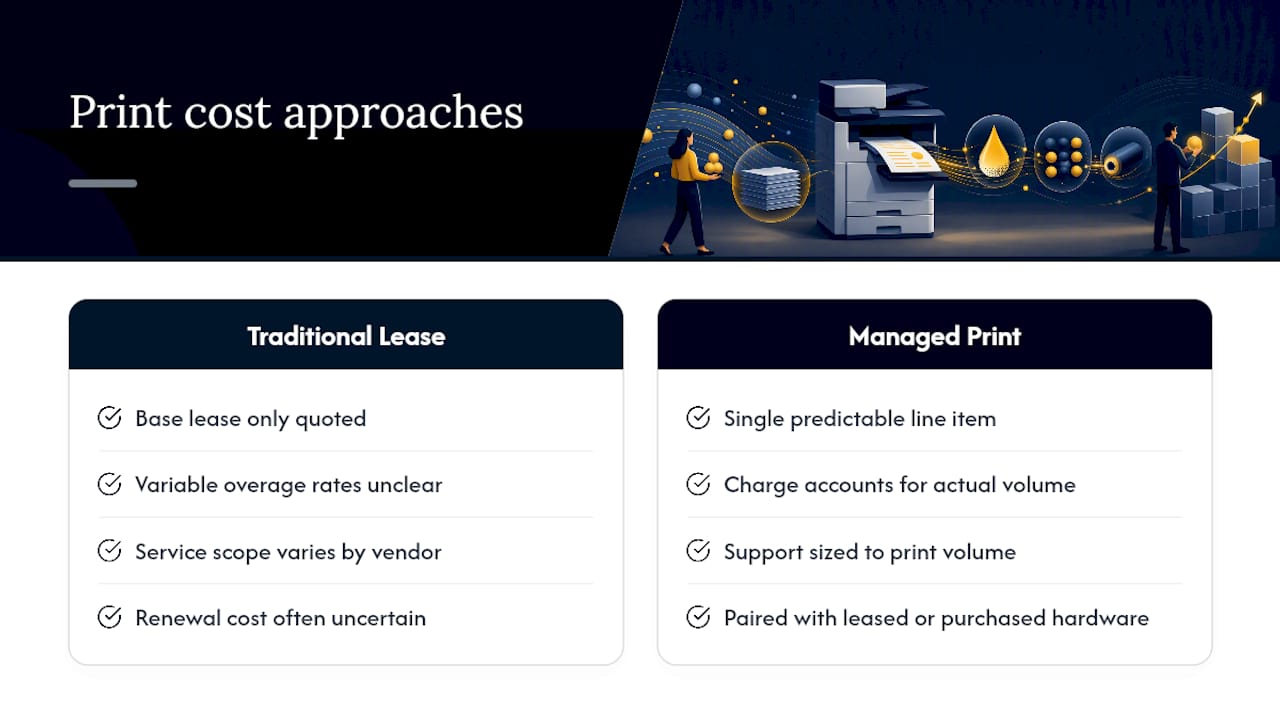
A managed print arrangement changes that equation by converting those variables into a single predictable line item. Instead of guessing at overage exposure every quarter, a business gets one service and lease charge that already accounts for its actual volume. Managed Print Services from Mavericks Office Solutions is built around that same logic, pairing leased or purchased hardware with a support structure sized to how much a business actually prints, backed by a USA-based help desk rather than an offshore queue.
The bigger point holds regardless of vendor: the businesses that budget best are the ones that price the whole program, not just the machine.
— Jeffrey
Get a Straight Answer on Your Own Copier Costs
Comparing lease quotes on your own means chasing down itemized numbers from three or four dealers and normalizing them yourself, a task most office managers don’t have a free afternoon for. Some providers handle that comparison work directly, pairing copier leasing with a managed service and supply structure so your monthly print cost stops being a guessing game.

Because print, IT support, and phone systems run through one provider here, you’re not juggling separate vendors for the copier, the help desk, and the network it sits on. If leasing versus buying is still an open question for your office, our breakdown of the two paths walks through the trade-offs in more depth. When you’re ready for real numbers, use the Copier Quote Wizard to get a custom quote built around your actual monthly volume instead of a generic rate card.
Sources
- Office Copier Cost 2026: Buy & Lease Price Guide
- How to Get Out of a Copier Lease Without Penalties – LegalClarity
- Understanding Copier Lease Buyouts: A Simple Guide – Copier Lease Center
FAQ
Is It Cheaper to Buy or Lease a Copier?
Buying is usually cheaper over the full life of the machine, but leasing bundles maintenance and supplies and preserves cash flow, which is why many small businesses accept a total cost that runs 30 to 50 percent higher over five years in exchange for predictable monthly budgeting.
Can You Get Out of a Copier Lease?
Yes, though it typically requires a buyout payment equal to the present value of remaining payments plus residual value, or negotiating a lease transfer, settlement, or rollover into a new agreement.
How Does a Copier Lease Work?
You pay a fixed monthly amount for a set term, usually 12 to 60 months, in exchange for use of the equipment plus (in most cases) maintenance and service; at term-end you either return the machine, renew, or exercise a buyout depending on whether the lease is FMV or $1 buyout structured.
How Much Does It Cost to Rent a Photocopier?
Typical monthly costs run $125 to $450 for most small and mid-sized offices, with light desktop use closer to $50 to $125 and high-volume departments exceeding $600, depending on speed, color capability, and page volume.
What’s the Biggest Hidden Cost in a Copier Lease?
Meter overage charges and end-of-lease fees are the most common surprises, since quotes often hide these differences behind an attractive base monthly payment.