

An incident response plan is a senior-approved playbook that spells out who does what the moment a security incident hits your business. It covers detection through recovery and every role in between. If you don’t have one yet, your first move is simple: name an Incident Manager today and adopt a written template this week, before you refine anything else.
TL;DR:
- Developing a clear severity matrix for your incident response plan ensures quick decision-making and reduces delays during critical moments.
- Testing your plan through tabletop exercises, simulations, and full-scale drills helps expose gaps and prepares the team for real incidents.
- Regularly reviewing and updating your plan, especially after major changes or actual incidents, is essential to maintain effectiveness and compliance.
- Engaging a managed IT provider can streamline response coordination, ensure SLA adherence, and support detection, containment, and recovery efforts.
- Using official templates from NIST, CISA, or AWS helps achieve specificity and consistency, avoiding vague or generic procedures that lack actionable detail.
Table of Contents
- What Is an Incident Response Plan, and Why Does It Matter?
- What Are the Core Phases of Incident Response?
- Who Should Be on Your Incident Response Team?
- What Should Go in Your Incident Response Playbooks?
- How Do You Know When to Declare an Incident?
- How Often Should You Test Your Incident Response Plan?
- How Do You Keep an Incident Response Plan Current?
- How Does a Managed IT Partner Operationalize an Incident Response Plan?
- An Editorial Take on Building an Incident Response Plan
- Should You Build Your Incident Response Plan In-House or Bring in Support?
- Where to Find Official Incident Response Templates and Guidance
- Sources
What Is an Incident Response Plan, and Why Does It Matter?
An incident response plan is a formally approved document that tells your team what to do before, during, and after a confirmed or suspected security incident. It exists to remove guesswork at the worst possible moment. According to the Cybersecurity and Infrastructure Security Agency, that approval has to come from senior leadership, not just the IT department, because an incident response plan authorizes people to take actions (shutting down systems, notifying customers, contacting law enforcement) that carry real business consequences.
An incident response plan doesn’t stand alone. It’s one piece of your broader cyber incident management program, and it should connect directly to your risk management plan and IT disaster recovery plan. NIST SP 800-61r3 treats incident response as embedded across an organization’s risk functions rather than a bolt-on checklist.
Before you finalize anything, make sure it includes:
- A named executive sponsor who signs off on the plan annually
- Version control so everyone works from the current copy, not last year’s draft
- A distribution method that works even if your network is down (a printed binder counts)
- Defined links to your business continuity and disaster recovery plans
What Are the Core Phases of Incident Response?
Every credible security breach plan follows the same six-phase structure that NIST documents in SP 800-61r3. Here’s what belongs in each phase of your incident response workflow.
- Detect. Capture alerts from your SIEM, endpoint tools, and help desk tickets. Log the first indicator, timestamp, and source system immediately, since this becomes your forensic timeline’s starting point.
- Analyze. Determine scope: which systems, accounts, and data are affected. Preserve logs and disk images before you touch anything, and document every action you take from this point forward.
- Contain. Choose short-term containment (isolate a device, disable an account) versus long-term containment (segment a network, rebuild from clean images). Short-term buys you time; long-term stops recurrence.
- Eradicate. Remove the root cause, whether that’s malware, a compromised credential, or a misconfigured firewall rule. Confirm the vulnerability that allowed entry is actually closed, not just patched cosmetically.
- Recover. Restore systems from verified clean backups, monitor closely for signs of reinfection, and validate data integrity before declaring normal operations resumed.
- Lessons learned. Build a timeline, run a blameless retrospective, and update the plan itself. This phase is where most organizations quietly skip a step and repeat the same mistake next year.
Pro Tip: Assign one person to keep a running incident log with timestamps from the moment detection occurs. During chaos, nobody remembers what happened at 2:47 a.m. unless someone wrote it down in real time.
Who Should Be on Your Incident Response Team?
Your incident response team needs defined roles before an incident, not during one. At minimum, you need an Incident Manager, a Technical Manager, a Communications Manager, a legal liaison, and representation from affected business units.
- Incident Manager: owns the overall response, enforces decision deadlines, and prevents the team from getting stuck debating instead of acting.
- Technical Manager: leads containment, eradication, and recovery work across systems.
- Communications Manager: drafts internal updates, customer notifications, and coordinates with PR if the incident becomes public.
- Legal liaison: advises on breach notification obligations and evidence handling.
- Business unit leads: confirm operational impact and help prioritize what gets restored first.
A simple RACI pattern keeps this from turning into a committee. The Incident Manager is Accountable for the overall response and holds final decision authority for moderate incidents. For severe incidents, that authority escalates to an executive sponsor, who becomes Accountable while the Incident Manager stays Responsible for execution. Technical staff are Responsible for containment tasks; legal and communications are Consulted before any external statement goes out; the board is Informed once an incident crosses a severity threshold you define in advance.
Pro Tip: Write your RACI on one page and pin it inside the plan itself. If people have to search for who decides what, you’ve already lost minutes you can’t get back.
What Should Go in Your Incident Response Playbooks?
Playbooks turn your incident response plan from theory into a repeatable incident response workflow. Each one needs the same core fields, based on the reusable structure AWS Well-Architected recommends for cloud and on-premises environments alike:
- Prerequisites: tools, access levels, and logging that must already be in place
- Detection queries or signals: what triggers this specific playbook
- Stakeholder contact list: who gets called, in what order, with backup contacts listed
- Step-by-step containment and eradication actions: written so a tired analyst at 3 a.m. can follow them
- Expected outcomes: how you confirm the incident is actually resolved, not just quiet
Build your first four playbooks around the incidents most likely to hit a small or midsize business: ransomware, phishing, credential compromise, and denial-of-service attacks. Ransomware and phishing deserve priority since they account for the overwhelming majority of incidents smaller organizations actually face. A dedicated ransomware prevention playbook, built before an attack rather than during one, is worth the afternoon it takes to draft.
How Do You Know When to Declare an Incident?
Vague thresholds cause paralysis. Teams debate whether something “counts” as an incident while the actual damage spreads. A written severity matrix removes that debate entirely.
A workable three-tier structure looks like this:
- Low severity: isolated to one system, no data exposure suspected. Handled by IT staff, no executive notification required.
- Medium severity: multiple systems affected or sensitive data possibly exposed. Incident Manager activates the full team; legal reviews notification obligations.
- High severity: confirmed data breach, ransomware, or business-critical outage. Executive sponsor notified immediately, external counsel and regulators engaged as required.
Severity level should automatically trigger your data breach notification clock. Many state and federal rules start counting from discovery, not confirmation, so waiting to “be sure” before declaring can cost you compliance time you didn’t budget for.
How Often Should You Test Your Incident Response Plan?
A plan nobody has tested is a guess dressed up as a document. NIST’s CSF 2.0 Community Profile treats regular, repeatable testing as central to reducing incident impact, not optional polish.
- Tabletop exercises: a facilitator walks the team through a scenario verbally. Run these regularly. They’re cheap, fast, and reliably expose gaps in your crisis communication plan that nobody noticed on paper.
- Simulated attacks: a controlled, technical exercise (a phishing simulation, a contained ransomware drill) that tests actual detection and containment tools. Run these regularly.
- Full-scale exercises: an unannounced or semi-announced drill involving the whole incident response team, executives, and sometimes external partners. Run one regularly.
After every real incident and every exercise, run a blameless retrospective immediately, while details are fresh. Convert every finding into a specific, time-boxed action item with a named owner. Findings that don’t get an owner tend to vanish quietly by the next quarter.
Pro Tip: Score your tabletop exercises on a simple pass/fail per playbook step. It turns a vague “that went fine” into evidence you can show leadership when budget season comes around.
How Do You Keep an Incident Response Plan Current?
Set a review schedule and stick to it. Most organizations review their full plan annually at minimum, but certain events should trigger an immediate update regardless of calendar timing: a merger or acquisition, a major system migration, a new regulatory requirement, or any real incident that exposed a gap.
- Store the master copy somewhere accessible even during an outage, not solely on the network it’s meant to protect.
- Assign one owner responsible for version control and change history.
- Cross-reference your IRP against your business continuity plan so recovery priorities don’t contradict each other.
- If you run workloads in the cloud, confirm your plan accounts for the shared responsibility model. Your provider secures the infrastructure; you’re still responsible for configuration, access, and data. AWS guidance is explicit that cloud playbooks need to specify which party executes each step.
Aligning your business continuity planning with your incident response plan prevents the two documents from working against each other during an actual outage.
How Does a Managed IT Partner Operationalize an Incident Response Plan?
Writing a plan and running one under pressure are different skills. Many small and midsize businesses have the first covered and lack the second: 24/7 monitoring, forensic capacity, and a team that has actually executed containment before.
Mavericks Office Solutions operates as a full outsourced IT department, combining managed IT services, cybersecurity, voice communication, and print management under one contract instead of five vendors. That matters during an incident, when coordinating multiple providers wastes exactly the minutes you don’t have.
If you’re evaluating any managed detection and response or managed IT partner to support your plan, check these before you sign anything:
- Does their SLA specify a response time, and is it documented, not just implied?
- Do they participate in your tabletop exercises, or only show up once something breaks?
- Is their escalation path written into your plan by name, not just “call support”?
- Can they support endpoint detection and response as part of your containment playbook, not as a separate add-on?
An Editorial Take on Building an Incident Response Plan
Most incident response plan guides suffer from the same flaw: they explain the theory beautifully and leave the reader with nothing to actually copy into a document. That’s backwards. The CISA template and NIST’s lifecycle exist precisely so nobody has to invent phase names from scratch. Your job isn’t originality. It’s specificity: exact contacts, exact thresholds, exact playbook steps.
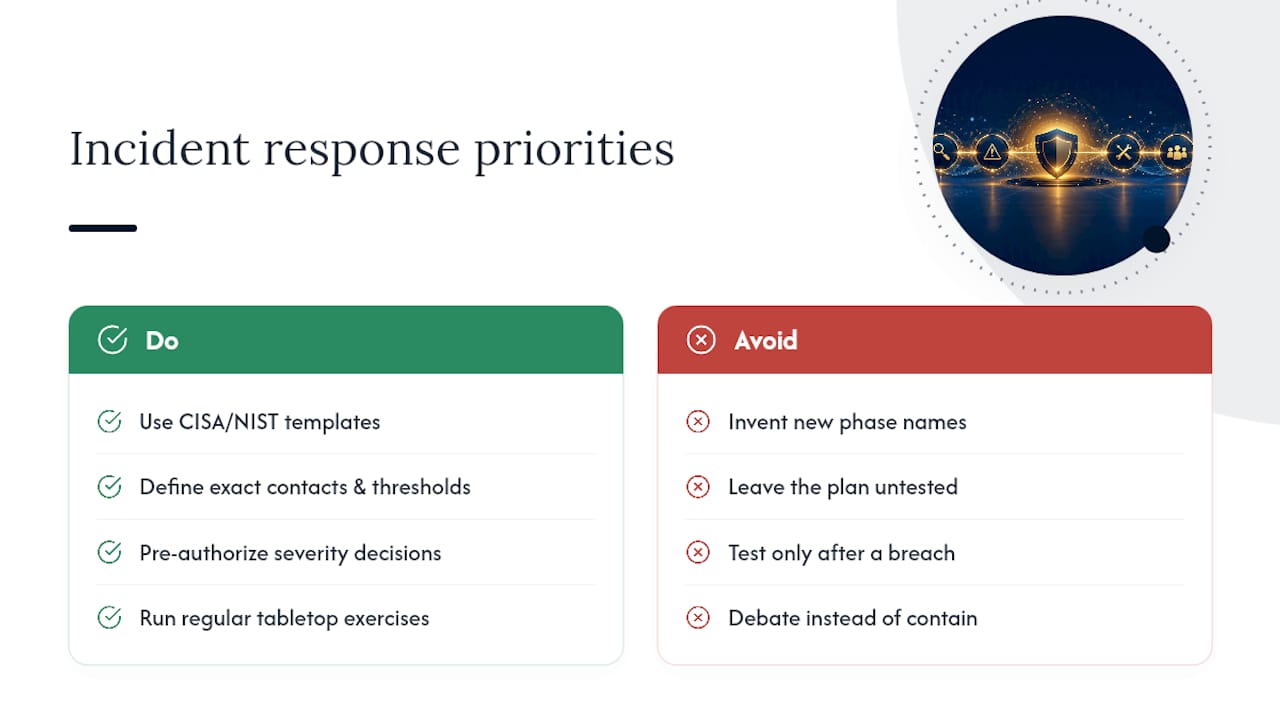
Where conventional advice falls short is testing. Plenty of organizations write a thorough plan, get it approved, and then never run a tabletop exercise until an actual breach forces the issue. A plan tested zero times is a hypothesis, not a capability.
If you take one thing from this guide, prioritize the severity matrix before anything else. Teams don’t fail during incidents because they lack technical skill. They fail because nobody had pre-authorized the decision to act, so precious time went to debate instead of containment. Fix that first, then build the rest around it.
— Jeffrey
Should You Build Your Incident Response Plan In-House or Bring in Support?
Building and testing an incident response plan solo takes real time: research, drafting, tabletop coordination, and keeping pace with evolving threats like ransomware and credential compromise. Mavericks Office Solutions gives you a working alternative to going it alone, matching specific services directly to the phases covered above: managed detection and response for the detect and analyze phases, a local USA-based help desk for round-the-clock escalation, and backup and recovery support that ties directly into your eradication and recovery steps.

Engaging a managed IT partner means you get documented SLAs, participation in your tabletop and simulation exercises, and a help desk that provides timely responses, not a ticket queue that sits overnight. That’s the operational gap most in-house teams struggle to close without hiring a dedicated security staff. Explore managed IT services built for exactly this, or review the cybersecurity offerings to see how detection, response, and recovery fit under one contract. If you’re weighing an outsourced model against building in-house, the outsourced IT department comparison breaks down costs and structure. Reach out for an assessment and find out where your current plan has gaps before an incident finds them for you.
Where to Find Official Incident Response Templates and Guidance
- NIST SP 800-61r3: the standard framework for detection, containment, eradication, and recovery.
- CISA Incident Response Plan Basics: a downloadable template with roles and structure guidance.
- AWS Security Incident Response Guide: cloud-specific playbooks and automation examples.
- For a broader cybersecurity compliance overview, this cybersecurity guidance resource covers adjacent protection practices worth reviewing.
Sources
- Incident Response Plan (IRP) Basics — CISA
- Computer Security Incident Handling Guide (NIST SP 800-61r3)
- AWS Security Incident Response Guide