

Managed detection and response (MDR) is a 24/7 cybersecurity service that combines advanced technology with human security analysts to monitor, detect, investigate, and actively respond to threats on your behalf. Unlike traditional tools that simply generate alerts for your team to chase down, MDR providers operate a full security operations center (SOC) and take ownership of containment when a threat is confirmed.
Here is what a strong MDR service delivers:
- Continuous monitoring of endpoints, networks, and cloud environments around the clock
- Proactive threat hunting where analysts search for attacker behavior before automated alerts fire
- Active incident response including isolating compromised devices, blocking malicious connections, and removing malware
- Root cause analysis to prevent the same attack from recurring
- Alert triage that filters false positives so your team only sees verified threats
The core distinction from older security models is response ownership. MDR providers take contractual responsibility for containment, not just notification. For Michigan businesses without a dedicated security team, that difference is the whole point.
How managed detection and response services actually work

MDR follows a repeatable operational cycle that runs continuously, day and night.
| Workflow Stage | Technology Used | Analyst Role |
|---|---|---|
| Data collection | EDR agents, SIEM, network sensors | Configure and tune collection sources |
| Alert triage | AI-driven correlation and scoring | Filter false positives, prioritize real threats |
| Threat hunting | Behavioral analytics, threat intelligence | Proactively search for hidden attacker activity |
| Investigation | Forensic tooling, log analysis | Determine scope, impact, and attack path |
| Containment | Automated playbooks, remote isolation | Execute or approve containment actions |
| Remediation | Patch management, malware removal | Restore systems to a clean state |
| Reporting | Dashboards, weekly/monthly reports | Communicate findings and recommendations |

The technology layer handles speed and scale. AI-assisted triage processes enormous volumes of alerts and flags the ones that warrant human attention. Analysts then apply judgment that automated systems cannot replicate, distinguishing a genuine intrusion from normal operational noise at 2 AM. Proactive threat hunting adds a forward-looking layer, actively searching for attacker behavior that has not yet triggered any automated alert.
How MDR compares to EDR, MSSP, and SIEM
These terms get used interchangeably, but they describe fundamentally different things.
- MDR vs. EDR: EDR is a software tool that monitors endpoints and generates detection data. It requires your internal team to investigate and act on every alert. MDR is a managed service that wraps human analysts and active response around that technology layer, so you are not dependent on in-house staff to respond.
- MDR vs. MSSP: MDR includes active response capabilities that most traditional MSSPs do not. A standard MSSP sends validated alerts to your team and expects you to handle containment. MDR providers contain the threat themselves. That said, many MSSPs now offer MDR as part of their portfolio, so the lines overlap.
- MDR vs. SIEM: A managed SIEM collects and analyzes log data to surface security events. It relies heavily on rules and event correlation, with no built-in human response layer. MDR adds proactive hunting and active containment on top of what SIEM surfaces.
- MDR vs. XDR: XDR is a technology platform that unifies telemetry across endpoints, networks, cloud, and identity. It gives your security team better visibility. MDR provides the security team itself. Organizations without 24/7 analyst coverage typically need MDR; those with mature internal teams may prefer XDR for better tooling.
Pro Tip: If your primary gap is not having someone available to act on threats outside business hours, MDR closes that gap directly. XDR improves what your existing team can see, but it does not replace the team.
What MDR actually does for your business
The business case for MDR comes down to speed and expertise. MDR can reduce time to detect and respond from months to minutes, which directly limits how far an attacker can move through your environment before being stopped. In AI-enhanced MDR deployments, approximately 52% of security cases are resolved automatically without human intervention, with an average response time of 89 seconds from alert to containment.
Key business benefits include:
- Faster breach containment that limits data loss and operational disruption
- Reduced alert fatigue for your internal IT staff, who no longer need to triage every security event
- Access to specialized expertise without hiring full-time security analysts
- Compliance support through continuous monitoring and documented incident response
- Cost efficiency since MDR typically costs more than a basic MSSP but eliminates the far greater expense of staffing an internal SOC
For small and mid-sized Michigan businesses, the staffing argument alone is often decisive. Experienced threat hunters and incident responders are expensive and hard to recruit.
How to implement MDR in your organization
Getting MDR right starts before you sign a contract.
- Assess your current security posture. Identify what monitoring you already have, where your gaps are, and which systems hold your most sensitive data.
- Define integration requirements. MDR providers need to ingest telemetry from your endpoints, firewalls, cloud platforms, and identity systems. Confirm compatibility with your existing tools early.
- Clarify SLAs and response time commitments. Ask for specific guarantees on mean time to respond (MTTR) and what “response” actually means in the contract.
- Establish incident response roles. Decide which containment actions the MDR provider can take autonomously and which require your approval. Ambiguity here causes dangerous delays during live incidents.
- Plan for onboarding time. MDR services typically reach active monitoring within days, far faster than deploying and tuning an XDR platform, but you still need to allocate internal time for the initial setup.
Common challenges include alert tuning during the first few weeks, staff resistance to ceding response control, and ensuring the provider understands your business context well enough to avoid disrupting critical systems during containment.
Pro Tip: Before signing, ask the provider directly: “Who owns the response, and do any containment actions require our manual approval?” The answer tells you whether you are buying active response or just faster alerting.
Top managed detection and response providers in Michigan
Michigan businesses have several strong local and regional options. The providers below serve the Michigan market with varying specializations, service depths, and client profiles.
| Provider | Core Services | Detection & Response | Local Presence | Certifications/Partners | Best For | Rating |
|---|---|---|---|---|---|---|
| Leet Services | Managed IT, cybersecurity, cloud, infrastructure | 24/7 monitoring, EDR, security partnerships | Michigan-based | Bitdefender, Sophos, Microsoft, Huntress Labs, Blackpoint Cyber | SMBs needing scalable managed IT and security | 5★ (79 reviews) |
| CTS Companies | Full managed IT, cybersecurity, network services | Broad security monitoring and management | Michigan-based | Not publicly listed | Businesses wanting full managed IT with strong local support | 4.8★ (58 reviews) |
| Michigan Network Consultants | Managed IT, network support, cloud security, remote worker support | Security consulting, cloud security management | Michigan-based | Not publicly listed | Small businesses and non-technical clients | 4.9★ (34 reviews) |
| Intelligent Technical Solutions (ITS) | Managed IT, cybersecurity, Detroit-area focus | Security coverage for SMBs | Detroit area | Not publicly listed | Detroit-area SMBs needing local managed IT and security | 4.5★ (36 reviews) |
| AdRem Systems Corporation | Managed IT, cybersecurity, Ann Arbor and Detroit | Security monitoring and response | Ann Arbor and Detroit | Not publicly listed | Michigan businesses needing local expertise and customer focus | 5★ (18 reviews) |
| Detection Systems and Engineering, Inc. | Managed security, monitoring, threat detection | Specialized detection and monitoring | Michigan-based | Not publicly listed | Organizations needing specialized security monitoring | 4.2★ (6 reviews) |
| Mavericksofficesolutions | Managed IT, cybersecurity, EDR, VoIP, print management, fractional IT | 24/7 monitoring, proactive patching, EDR, USA-based help desk | Michigan-serving | Leading security and network technology vendors | SMBs wanting a single provider for IT, security, and communications | — |
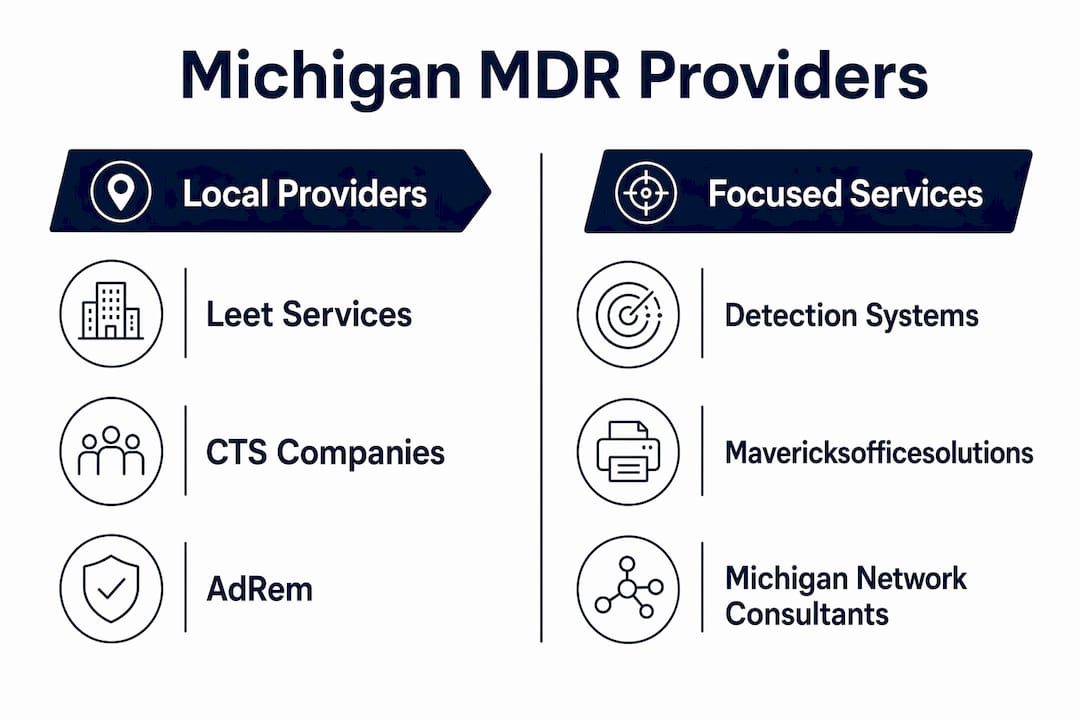
Leet Services stands out among Michigan SMB-focused providers for its certified security partnerships, including Huntress Labs and Blackpoint Cyber, two vendors specifically built for the managed security market. Their claim of 30% average savings versus in-house IT staff gives budget-conscious decision makers a concrete benchmark to evaluate.
CTS Companies covers the full managed IT spectrum with a reputation for strong local customer relationships across Michigan. For businesses that want one partner handling everything from network management to cybersecurity without deep specialization in any single area, CTS is a practical fit.
Michigan Network Consultants targets small businesses and clients who are not technically sophisticated. Their focus on remote worker support and cloud security consulting makes them a natural fit for distributed teams or businesses transitioning to cloud-first environments.
Intelligent Technical Solutions (ITS) concentrates on the Detroit metro area, offering managed IT and security coverage tailored to growing SMBs in that market. Their local presence means faster on-site response when remote support is not enough.
AdRem Systems Corporation serves both Ann Arbor and Detroit with a customer-centric approach and deep local knowledge. For Michigan businesses that prioritize a provider who understands the regional business environment, AdRem is worth a serious look.
Detection Systems and Engineering, Inc. focuses specifically on security monitoring and detection engineering rather than broad managed IT. Organizations that already have IT support but need a dedicated security monitoring layer will find this specialization useful.
Mavericksofficesolutions takes a different approach from the pure-play IT providers above. As a full outsourced IT department, it bundles managed IT and cybersecurity with VoIP, print management, and fractional IT leadership under one monthly contract. The USA-based help desk with an average response under 12 minutes addresses one of the most common frustrations with outsourced IT: slow support. For Michigan SMBs that want a single accountable partner across all their technology needs, not just security, Mavericksofficesolutions is the strongest fit in this list.
How to choose the right MDR provider for your business
The right provider depends on your business size, internal IT capacity, and risk profile. Work through these questions before making a decision:
- Does the provider take active response ownership, or do they just alert you? This is the single most important distinction. Confirm it in writing in the contract.
- What is the guaranteed response time? Ask for MTTR commitments, not just monitoring uptime.
- Which certifications and security partnerships does the provider hold? Partnerships with vendors like Microsoft, Sophos, or Huntress Labs indicate access to current threat intelligence and tooling.
- Can they integrate with your existing security tools? Replacing your entire stack is expensive and disruptive. A good MDR provider works with what you have.
- Do they offer local on-site support? Remote response handles most incidents, but some situations require physical access to your systems.
- What compliance reporting do they provide? If you operate under HIPAA, PCI DSS, or other frameworks, confirm the provider’s reporting capabilities match your audit requirements.
- What does the contract look like? Month-to-month flexibility versus long-term commitments affects your ability to switch providers if the relationship is not working.
Pro Tip: Ask any shortlisted provider for a sample incident report from a past engagement. The quality of that documentation tells you more about their actual response capability than any sales conversation.
What Mavericksofficesolutions brings to cybersecurity in Michigan
Mavericksofficesolutions operates as a complete outsourced IT department, not just a security vendor. Their cybersecurity services include 24/7 monitoring, proactive patching and updates, and endpoint detection and response, all backed by a USA-based help desk that answers in under 12 minutes on average.
Key capabilities include:
- 24/7 monitoring and proactive patching to close vulnerabilities before attackers exploit them
- Endpoint detection and response (EDR) for device-level threat visibility and containment
- Unlimited USA-based help desk with on-site dispatch, no offshore routing
- Certifications with leading security and network technology vendors
- Fractional IT leadership through virtual CIO and CTO services for businesses that need executive-level technology strategy without a full-time hire
- Unified communications and print management bundled with IT and security under one contract
For Michigan SMBs that are tired of managing multiple vendors for IT, security, phones, and printing, Mavericksofficesolutions consolidates all of it into a single monthly relationship.
Mavericksofficesolutions: a full-service alternative for Michigan businesses
The providers compared above are strong options for managed security. Mavericksofficesolutions serves a slightly different need: businesses that want their entire technology operation handled by one local partner, not just the security piece.
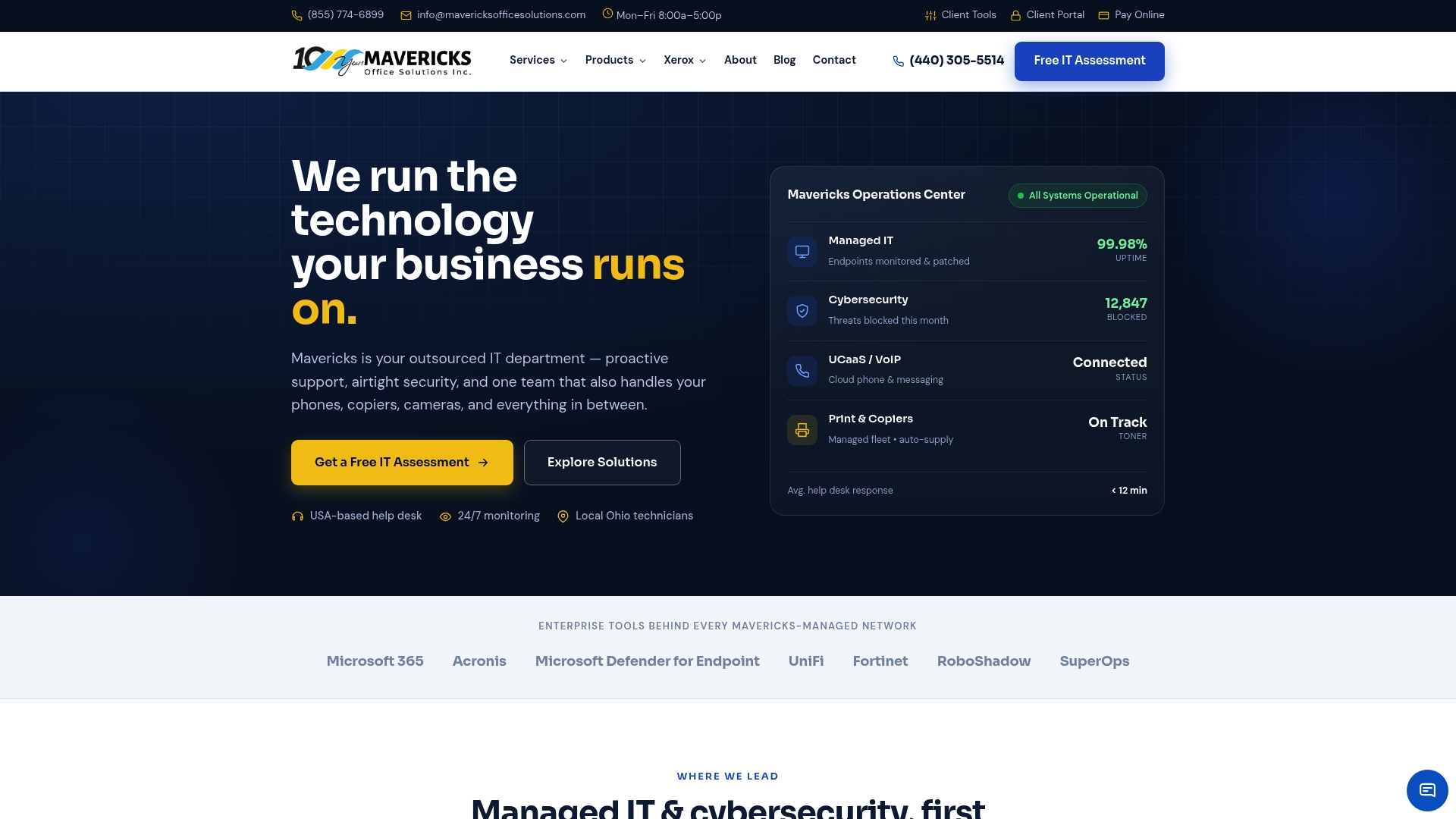
Where most MDR providers focus exclusively on threat detection and response, Mavericksofficesolutions covers managed IT, cybersecurity, VoIP, print management, and fractional IT leadership together. That means one contract, one point of contact, and one team that understands your full technology environment, not just your security stack. The under-12-minute help desk response time is a concrete operational advantage for businesses where IT downtime has a direct cost.
If you are a Michigan SMB looking for a partner that handles security as part of a broader IT relationship, explore Mavericksofficesolutions’ managed IT services to see whether the full-service model fits your situation.
Key Takeaways
MDR delivers the fastest path to 24/7 expert threat response for businesses that lack the internal staff to monitor and contain attacks around the clock.
| Point | Details |
|---|---|
| MDR vs. alerting tools | MDR providers take active response ownership; SIEM and basic MSSPs only surface alerts for your team to act on. |
| Speed advantage | AI-enhanced MDR resolves approximately 52% of cases automatically, with an average response time of 89 seconds from alert to containment. |
| Choosing MDR vs. XDR | Choose MDR when you lack 24/7 analyst coverage; choose XDR when you have an internal security team that needs better tooling. |
| Provider selection criteria | Verify active response ownership, MTTR guarantees, certifications, and local on-site support before signing. |
| Mavericksofficesolutions | Bundles managed IT, cybersecurity, EDR, VoIP, and print management under one contract with a USA-based help desk averaging under 12 minutes response. |