

If your organization handles customer financial data as defined by the Federal Trade Commission, you must have a written information security program in place right now. The FTC Safeguards Rule under 16 CFR Part 314 applies to a broader range of businesses than most compliance officers expect, and the post-2024 breach-reporting amendment added real teeth to enforcement. Here is what you need to do immediately:
- Designate or confirm a Qualified Individual with both technical authority and executive access to implement your information security program.
- Check your threshold for the number of affected consumers. If a breach exposes unencrypted customer information affecting many consumers, you must notify the FTC within 30 days of discovery.
- Verify encryption status and key custody. If an unauthorized party accessed your encryption key, the data is treated as unencrypted for notification purposes, regardless of whether the files themselves were scrambled.
- Update your written risk assessment. A stale assessment is the single most common audit failure.
- Confirm vendor contracts include safeguard obligations. Service providers with access to customer information must be contractually required to maintain appropriate protections.
The highest-risk exposures are unencrypted customer records, service-provider remote access without multi-factor authentication (MFA), and missing or outdated incident response plans. Start with those three. For authoritative rule text, go directly to 16 CFR Part 314 and the Federal Register notice.
Key Takeaways
FTC Safeguards Rule compliance requires a written information security program with nine documented elements, a designated Qualified Individual, and a breach-notification process triggered by unauthorized acquisition of unencrypted customer information affecting 500 or more consumers.
| Point | Details |
|---|---|
| Notification threshold | Report to the FTC within 30 days when unencrypted customer data affecting 500+ consumers is acquired without authorization. |
| Encryption-key rule | If an unauthorized party accessed the encryption key, the data is treated as unencrypted, regardless of file-level encryption. |
| Qualified Individual | Can be internal or external, but must have technical authority and report to the board at least annually. |
| Vendor oversight | Contracts must require safeguards; providers must be assessed periodically, not just at onboarding. |
| Mavericks Office Solutions | Provides managed IT, cybersecurity, and fractional IT leadership mapped to 16 CFR Part 314 obligations for Ohio and Michigan businesses. |
Table of Contents
- Who does the Safeguards Rule actually cover?
- What your written information security program must include
- How to handle breach reporting under the updated rule
- How to manage service provider risk under the rule
- Who can serve as your Qualified Individual?
- Your phased implementation roadmap: 30 days through 12 months
- Common compliance gaps and how to fix them fast
- How a managed IT partner implements the Safeguards Rule for you
- What compliance officers get wrong about the Safeguards Rule
- Mavericks Office Solutions helps you meet Safeguards Rule obligations
- Sources
Who does the Safeguards Rule actually cover?
The FTC’s definition of “financial institution” is functional, not industry-label-based. If your organization is engaged in a financial activity, even incidentally, you may be covered. Many businesses assume they are exempt because they do not call themselves a bank or lender. That assumption is wrong, and the FTC has said so explicitly.
Under 16 CFR Part 314, covered entities include nonbank financial institutions subject to FTC jurisdiction. The rule lists 13 illustrative examples, including mortgage lenders, payday lenders, finance companies, mortgage brokers, account servicers, check cashers, wire transferors, travel agencies in connection with financial services, collection agencies, credit counselors, tax preparation firms, non-federally insured credit unions, and investment advisors not registered with the SEC.
Coverage self-screening checklist:
- Does your organization originate, broker, or service loans?
- Do you process payments, wire transfers, or check cashing?
- Do you prepare tax returns or provide credit counseling?
- Do you offer dealer financing or lease financing as part of a sale?
- Do you collect debts or purchase charged-off accounts?
- Do you act as a finder, connecting consumers with lenders?
- Do you hold, transmit, or process nonpublic personal financial information?
If you checked any of these, the Safeguards Rule almost certainly applies to you.
What counts as “customer information”? The Rule covers nonpublic personal information (NPI) about consumers who obtain financial products or services primarily for personal, family, or household purposes. That includes names, Social Security numbers, account numbers, credit history, and any information derived from those records. Borderline cases include auto dealers who offer financing (covered), tax preparers who retain prior-year returns (covered), and loan servicers who receive transferred accounts (covered).
The GLBA connection: The Safeguards Rule implements the data-security duties imposed on FTC-jurisdiction entities by the Gramm-Leach-Bliley Act (GLBA). It coexists with rules from other regulators, such as the OCC, FDIC, and state insurance commissioners, each of which may impose parallel or stricter requirements on their own supervised entities. If your organization is subject to both HIPAA and the Safeguards Rule, you need to map controls to both frameworks. Mavericks Office Solutions has experience doing exactly that for clients navigating HIPAA and IT compliance alongside Safeguards Rule obligations.
What your written information security program must include
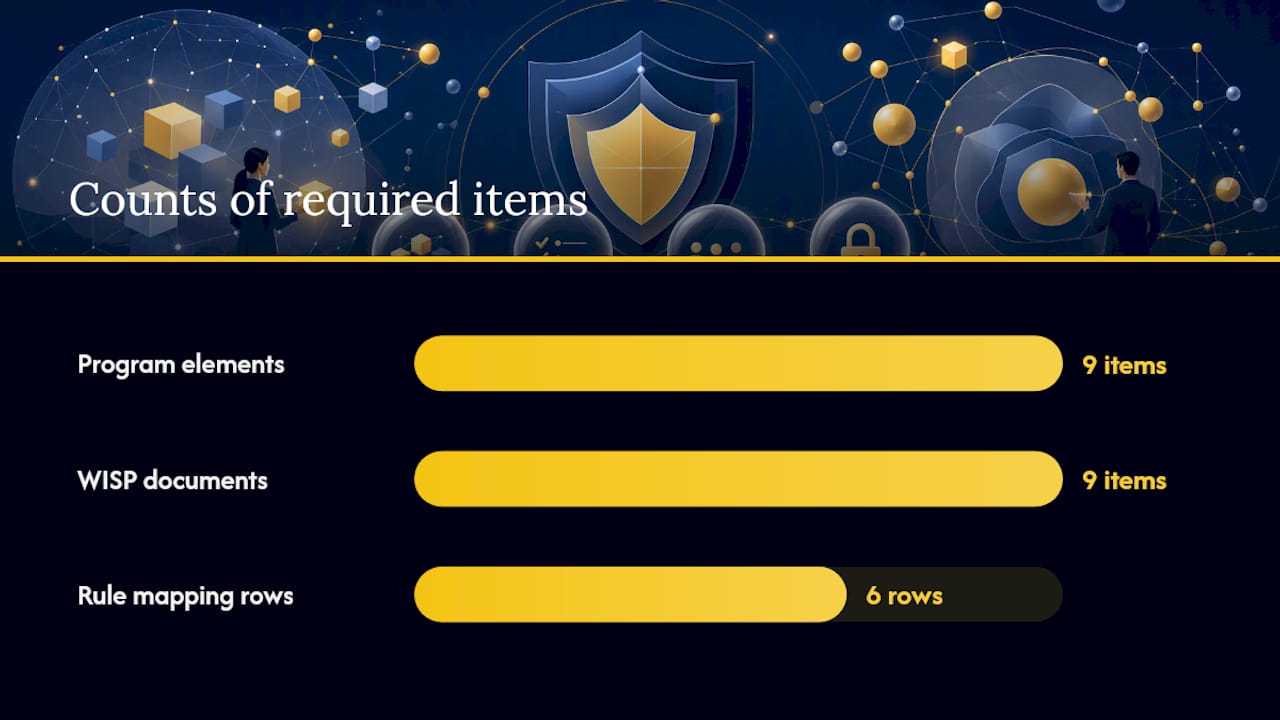
The Rule’s nine program elements under §314.4 are not suggestions. Each one requires a documented, implemented control, and the FTC expects evidence of all nine during an examination or enforcement action.
The nine required elements:
- Qualified Individual — Designate one person responsible for overseeing, implementing, and enforcing the program.
- Risk assessment — Identify foreseeable internal and external risks to customer information security, confidentiality, and integrity.
- Safeguards — Design and implement controls that address the risks identified in the assessment.
- Testing and monitoring — Regularly test or monitor the effectiveness of safeguards.
- Service provider oversight — Select and oversee providers that can maintain appropriate safeguards.
- Program updates — Evaluate and adjust the program in response to testing results, material changes, and new risks.
- Incident response plan — Establish a written plan for responding to security events.
- Board reporting — Report to the board of directors or equivalent governing body at least annually.
- Employee training — Train staff to implement the program.
What your Written Information Security Program (WISP) must document:
- A complete inventory of all systems, applications, and locations where customer information is stored or transmitted
- Data classification by sensitivity level and access need
- Access controls: role-based permissions, least-privilege enforcement, and privileged-account management
- Encryption policy covering data at rest and in transit, including key management procedures
- MFA requirements for any system accessing customer information, especially remote access
- Logging and monitoring: what is logged, how long logs are retained, and who reviews them
- Patch and change management procedures
- Data retention and secure disposal schedules
- Personnel training records and training content
The following table maps key regulatory requirements to practical controls:
| Rule Section | Requirement | Example Technical Controls | Example Administrative Controls |
|---|---|---|---|
| §314.4(b) | Risk assessment | Automated vulnerability scanning, asset discovery tools | Annual risk assessment document, risk register |
| §314.4©(1) | Access controls | Role-based access control (RBAC), privileged access management (PAM) | Access review policy, onboarding/offboarding procedures |
| §314.4©(3) | Encryption at rest and in transit | AES-256 encryption, TLS 1.2+, tested backup encryption | Encryption policy, key management procedures |
| §314.4©(5) | MFA | Authenticator apps, hardware tokens, FIDO2 keys | MFA enrollment policy, exception process |
| §314.4©(6) | Secure development | Code review, dependency scanning, SAST/DAST tools | SDLC policy, change management log |
| §314.4(d) | Testing | Penetration testing, vulnerability scans | Testing schedule, remediation tracking |
| §314.4(h) | Incident response | SIEM, EDR, automated alerting | Incident response plan, tabletop exercise records |
Pro Tip: Key management is where most encryption programs break down. Under the Rule, if an unauthorized person accesses the encryption key, the data is treated as unencrypted for notification purposes, even if the underlying files are encrypted. Store keys in a dedicated key management system (KMS) with strict access controls, and never co-locate keys with the data they protect. Audit key-access logs separately from general system logs.
For testing cadence, the Rule gives you two paths: continuous monitoring of your safeguards, or a combination of annual penetration testing and vulnerability scans at least every six months. Continuous monitoring is the stronger choice for organizations with dynamic environments or frequent system changes. Annual pen tests plus six-month scans may be sufficient for smaller, more static environments, but document your reasoning either way.
How to handle breach reporting under the updated rule
The breach-notification amendment took effect May 13, 2024. Since that date, covered institutions must report qualifying events to the FTC using an online form, no later than 30 days after discovery. Here is the step-by-step process your team should follow when a potential incident surfaces.
- Triage the incident. Determine whether customer information was accessed or acquired without authorization. Not every security event is a notification event.
- Count affected consumers. The threshold is 500 or more consumers. Count each individual whose information was involved, not the number of records or files.
- Determine encryption and key status. Per the final rule text, customer information is considered unencrypted if the encryption key was also accessed by the unauthorized party. Confirm with your key management system whether key access occurred.
- Assess whether the event qualifies. A notification event requires: (a) unauthorized acquisition, (b) of unencrypted customer information, © affecting a substantial number of consumers. All three conditions must be met.
- Collect required data points. The FTC expects: institution name and contact information, types of customer information involved, date or date range of the event, number of consumers affected, a general description of the event, and whether law enforcement has requested a delay in public notification.
- File via the FTC’s online form. Submit as soon as possible and no later than 30 days after discovery. Do not wait for a forensic investigation to conclude if you already have enough information to file.
- Document the law enforcement delay, if applicable. If law enforcement requests that you delay notifying the public (not the FTC), document that request and its basis. The FTC notification still proceeds on the 30-day clock.
One point that trips up compliance teams: the 30-day clock runs from discovery, not from the date you confirm all the details. File with what you know, and supplement if needed.
How to manage service provider risk under the rule
Obligations follow the data. Under §314.4(f), covered institutions must select service providers that can maintain appropriate safeguards, require those safeguards by contract, and periodically assess provider performance. The FTC’s guidance on vendor oversight makes clear that outsourcing a function does not outsource the compliance obligation.
Minimum contract clause requirements:
- A written commitment to implement and maintain safeguards appropriate to the sensitivity of the customer information they handle
- Encryption obligations for data at rest and in transit, with key management standards specified
- MFA requirements for any remote access to your systems or customer data
- Audit rights: your right to review, test, or receive attestations of the provider’s security controls
- Breach notification commitments: the provider must notify you within a defined window (typically 48–72 hours) of discovering an incident affecting your data
- Subprocessor rules: the provider must apply equivalent requirements to any subcontractors they engage
Vendor review checklist:
- Initial due diligence: Request SOC 2 Type II reports, penetration test summaries, and encryption/key management documentation before signing.
- Periodic risk-based assessments: Review providers annually at minimum; higher-risk providers (those with broad data access or remote system access) warrant more frequent review.
- Continuous monitoring signals: Watch for provider security advisories, news of breaches affecting the provider, changes in the provider’s ownership or subprocessors, and lapses in certification renewals.
Pro Tip: Validating a provider’s encryption and key custody is harder than it sounds. Ask specifically for proof of key separation (keys stored separately from encrypted data), KMS attestations, and the relevant sections of their SOC 2 report covering cryptographic controls. A provider that cannot produce these artifacts within a reasonable timeframe is a risk signal, not a paperwork delay.
For remote-access providers where a full audit is not feasible, require at minimum a written attestation of their security controls, evidence of MFA enforcement, and a copy of their incident response plan. Reviewing SaaS security controls for your cloud-based vendors is a practical starting point for this process.

Who can serve as your Qualified Individual?
The Qualified Individual is the organizational accountability mechanism for your entire information security program. Per FTC guidance, this person can be an employee or an external professional, but the covered institution must retain ultimate responsibility and supervise any outsourced work. You cannot simply hand the role to a vendor and walk away.
Minimum qualifications and authorities the Qualified Individual must have:
- Sufficient technical background to understand and evaluate the organization’s security risks and controls
- Direct reporting access to senior leadership or the board of directors
- Authority to implement program changes, including spending authority or the ability to escalate budget requests
- Oversight authority over service providers handling customer information
- Responsibility for the annual report to the board or equivalent governing body
Annual board report checklist:
- Overall status of the information security program
- Results of the most recent risk assessment, including identified risks and remediation status
- Summary of vendor risk reviews completed during the year
- Testing outcomes: penetration test findings, vulnerability scan results, and remediation progress
- Security events that occurred during the year, including near-misses, and corrective actions taken
- Proposed program changes or resource requests for the coming year
Internal vs. external Qualified Individual: Hire internally when you have a senior IT or security leader with the technical depth and organizational authority to own the program. Engage an external Qualified Individual or fractional security leader when your organization lacks that internal capacity, when the role would be part-time at your scale, or when you need a credentialed professional to satisfy the Rule’s requirements without a full-time hire. The external route is common and fully permitted, provided you maintain supervisory oversight of their work.
Your phased implementation roadmap: 30 days through 12 months
Getting into compliance is a sequenced effort. The first 30 days are about eliminating the highest-risk exposures. The next 60 days build the program structure. Months three through twelve mature it into a sustainable, auditable operation.
Days 1–30: Stop the bleeding
- Confirm or designate your Qualified Individual.
- Run an asset discovery scan to identify all systems storing or transmitting customer information.
- Verify MFA is enforced on all remote access points and privileged accounts.
- Confirm encryption status for data at rest and in transit; document key management procedures.
- Patch all critical and high-severity vulnerabilities identified in the asset scan.
- Review the top five vendor contracts for safeguard obligations; flag gaps for remediation.
Days 31–60: Build the program
- Complete or update the written risk assessment.
- Draft or revise the WISP to reflect current controls and the nine required elements.
- Establish a logging and monitoring baseline: what is captured, where it is stored, and who reviews it.
- Draft the incident response plan if one does not exist; update it if it predates the 2024 reporting amendment.
- Schedule the annual board report and confirm the reporting format.
Days 61–90: Close the gaps
- Complete vendor contract remediation for the remaining providers.
- Conduct initial personnel training on the WISP and incident response procedures.
- Run a vulnerability scan and document results.
- Establish the testing cadence: continuous monitoring or annual pen test plus six-month scans.
The following table maps key tasks to rule sections and estimated effort:
| Task | Rule Section | Estimated Effort |
|---|---|---|
| Designate Qualified Individual | §314.4(a) | Low |
| Asset inventory and data classification | §314.4(b) | High |
| Written risk assessment | §314.4(b) | High |
| MFA enforcement | §314.4©(5) | Medium |
| Encryption audit and key management | §314.4©(3) | Medium |
| WISP drafting or update | §314.4 (all) | High |
| Vendor contract review and remediation | §314.4(f) | Medium |
| Incident response plan | §314.4(h) | Medium |
| Personnel training | §314.4(i) | Low |
| Penetration test (initial) | §314.4(d) | Medium |
| Board reporting template | §314.4(a) | Low |
Months 6–12: Program maturity
Shift from one-time fixes to recurring operations: quarterly log reviews, a formalized vendor oversight cycle, a scheduled penetration test, and a board reporting cadence. Budget for continuous monitoring tools or a managed detection and response (MDR) service if you are not already using one.
Budgeting note: Tactical costs (initial pen test, gap assessment, WISP drafting) are largely one-time. Recurring costs include monitoring tooling or MDR service fees, SaaS licensing for identity and access management, and annual testing. Smaller entities maintaining customer information for fewer than 5,000 consumers are exempt from some formal requirements, such as written risk assessments and scheduled penetration testing, though most core safeguards still apply. Penalties for noncompliance can be substantial and are adjusted annually.
Common compliance gaps and how to fix them fast
These are the gaps that show up most often in audits. For each one, the fix is faster than most teams expect.
-
Stale risk assessment. The risk assessment has not been updated since a cloud migration, vendor change, or staff turnover. Fix: Schedule a risk assessment update within 30 days; treat it as a living document that changes whenever your environment changes. Estimated time: 1–2 weeks.
-
Missing or inconsistent MFA. MFA is enabled for some accounts but not all remote access or privileged accounts. Fix: Audit all remote access points and privileged accounts; enforce MFA universally within two weeks. Estimated time: 3–5 days.
-
Weak key management. Encryption keys are stored alongside the data they protect, or key access is not separately logged. Fix: Migrate to a dedicated KMS and configure separate access logging for key operations. Estimated time: 1–2 weeks.
-
Insufficient vendor controls. Vendor contracts lack explicit safeguard obligations, audit rights, or breach notification timelines. Fix: Identify the top 10 vendors by data access risk; send contract amendment requests with standard clause language. Estimated time: 2–4 weeks.
-
Inadequate logging. Logs do not capture privileged-account activity, remote access sessions, or failed authentication attempts. Fix: Expand logging scope and set a minimum retention period (90 days is a common baseline; one year is stronger). Estimated time: 1 week.
-
No formal incident response plan. The organization has informal procedures but nothing written, tested, or updated for the 2024 reporting amendment. Fix: Draft a plan using the FTC’s notification requirements as the framework; run a tabletop exercise within 60 days. Estimated time: 1–2 weeks.
-
Poor board reporting. The board receives no annual security briefing, or the briefing lacks the required content. Fix: Build a one-page reporting template covering program status, risk findings, testing results, and security events. Estimated time: 2–3 days.
-
Undocumented data inventory. No one knows exactly where customer information lives, which makes risk assessment and breach scoping nearly impossible. Fix: Run an asset discovery scan and data flow mapping exercise; document results in the WISP. Estimated time: 1–2 weeks.
Evidence to collect for audit readiness: WISP revision history with dates, penetration test reports and remediation tracking, vendor attestations and SOC 2 reports, training completion logs, board meeting minutes referencing the annual security report, and incident response tabletop exercise records.
Common misinterpretation to avoid: “Password-protected” does not equal encrypted under the Rule. A password-protected ZIP file or PDF is not encrypted in the regulatory sense. Encryption requires a cryptographic algorithm applied to the data, with keys managed separately. If your team uses password protection and calls it encryption, correct that now.
How a managed IT partner implements the Safeguards Rule for you
A well-structured managed IT engagement maps specific deliverables to specific rule obligations. Here is what that looks like in practice, and what you should ask any provider before signing.
Deliverables mapped to rule obligations:
- Asset inventory and data classification → satisfies the risk assessment foundation under §314.4(b)
- Continuous monitoring and alerting → satisfies the testing and monitoring requirement under §314.4(d)
- Encryption configuration and key management → satisfies §314.4©(3)
- MFA rollout and enforcement → satisfies §314.4©(5)
- Vendor management support and contract review → satisfies §314.4(f)
- Incident response support and breach notification playbooks → satisfies §314.4(h)
- Board reporting templates and Qualified Individual support → satisfies §314.4(a)
What to expect in months 0–3 from a provider:
- Month 0: Discovery session, asset inventory scan, gap assessment against 16 CFR Part 314
- Month 1: Prioritized remediation plan with effort estimates; initial patching and MFA enablement
- Month 2: WISP draft or update; vendor contract review; logging baseline established
- Month 3: First vulnerability scan; incident response plan drafted; initial board report template delivered
Procurement questions to ask any provider:
- Who serves as or supports the Qualified Individual role, and what are their credentials?
- Can you provide a SOC 2 Type II report or equivalent evidence of your own security controls?
- How do you manage encryption keys for customer data, and can you provide KMS attestations?
- What does your breach notification playbook look like, and what are your SLA commitments for incident response?
- How do you document and report on your work to support our annual board briefing?
Mavericks Office Solutions maps its managed IT services directly to these obligations, including discovery, gap assessment, MFA rollout, and vendor contract review in the first 90 days. The work is implementation support, not legal advice; consult qualified legal counsel for legal determinations about your specific obligations.
What compliance officers get wrong about the Safeguards Rule
Most compliance programs fail not because teams lack knowledge of the Rule, but because they treat it as a documentation exercise rather than an operational one. The WISP gets written, filed, and forgotten. The risk assessment gets completed once and never touched again. The Qualified Individual gets named but given no real authority or budget.
The Rule is designed to be right-sized for your organization, which means the FTC does not expect a 50-person auto dealer to run a security operation like a regional bank. What the FTC does expect is that your program reflects your actual environment, that you update it when things change, and that someone with real authority owns it. The “right-sized” framing is not a loophole. It is an expectation that you have thought seriously about your specific risks.
The second mistake is underestimating the encryption-key rule. Teams spend significant effort encrypting data at rest and in transit, then store the keys in the same system. When a breach occurs, both the data and the key are compromised, and the notification obligation triggers. Key separation is not optional; it is the mechanism that makes encryption meaningful under the Rule.
The third mistake is treating vendor oversight as a one-time contract review. Providers change their subprocessors, their infrastructure, and their security practices. A vendor that passed your initial due diligence two years ago may not pass today. Build periodic reassessment into your calendar, not just your policy document.
Mavericks Office Solutions helps you meet Safeguards Rule obligations
Staying compliant with the FTC Safeguards Rule requires more than a policy document. It requires continuous monitoring, tested controls, vendor oversight, and someone accountable for the whole program. For small and mid-sized businesses in Ohio and Michigan, Mavericks Office Solutions delivers exactly that as your outsourced IT department.

Mavericks maps its cybersecurity services directly to 16 CFR Part 314 obligations: 24/7 monitoring and managed detection and response for the testing requirement, MFA rollout and enforcement, encryption configuration, vendor contract review support, and incident response planning. For organizations that need a Qualified Individual without a full-time hire, Mavericks’ fractional IT leadership provides a credentialed professional with the executive mandate the Rule requires. The average help desk response time is under 12 minutes, with a USA-based team, no offshore handoffs.
A compliance discovery call with Mavericks delivers a gap assessment against 16 CFR Part 314, a prioritized remediation plan, and a budget estimate, all within the first engagement. Book your discovery call at Mavericksofficesolutions. This is implementation support, not legal advice; consult qualified legal counsel for legal determinations specific to your organization.
Sources
Use these sources to verify rule text, check plain-language guidance, and access the FTC’s official reporting tools.
- FTC Safeguards Rule: What Your Business Needs to Know | Federal Trade Commission
- 16 CFR Part 314 – Standards for Safeguarding Customer Information
- Standards for Safeguarding Customer Information | Federal Register
- FTC Safeguards Rule Checklist: Steps to Stay Compliant – LegalClarity
Recommended
- Why Every Ohio Small Business Needs a Cybersecurity Plan in 2026 – Mavericks Office Solutions
- HIPAA Compliance IT for Michigan: Your 90-Day Action Plan – Mavericks Office Solutions
- 7 AI Cybersecurity Mistakes Your Business Is Making – Mavericks Office Solutions
- SaaS Security Controls for Ohio SMBs: 2026 Guide – Mavericks Office Solutions