

Least privilege access means granting every user, account, and process only the minimum permissions needed to do its job, nothing more. The payoff is concrete: a smaller attack surface and a limited blast radius when something does go wrong. Getting there isn’t a one-time project. It takes ongoing governance to keep permissions from creeping back up over time.
TL;DR:
- Replace standing administrator rights with temporary grants lasting 1 to 4 hours, and pilot the admin domain that receives the most elevation requests.
- Give every service identity a named owner, narrow permissions, and scheduled credential rotation; scope automated agents per task with tokens that expire afterward.
- Connect HR role changes to automatic access updates, run recurring manager certifications, and give every emergency exception an expiration date and audit trail.
- Use role based access when job duties map cleanly to titles; choose attribute based rules when device health, department, or time changes access needs.
- Use access analyzers to flag unused permissions, and retain session recordings, certifications, and attestations as evidence; NIST SP 800-53 lists least privilege as AC-6.
Table of Contents
- What least privilege access actually means
- Why least privilege matters for your security posture
- The four surfaces where least privilege has to apply
- Implementation patterns that make least privilege practical
- Keeping permissions aligned over time
- Technical controls across your environment
- Measuring whether least privilege is actually working
- Common mistakes that undermine least privilege
- How least privilege fits into zero trust and NIST frameworks
- A phased checklist to enforce least privilege
- Why ongoing governance matters more than a one-time fix
- How we help you sustain least-privilege controls
- FAQ
- Sources
What least privilege access actually means
The Principle of Least Privilege requires that every user, process, or program receive only the access rights necessary to perform its legitimate function, no more. The goal is to shrink what an attacker or a mistake can reach, which directly reduces your organization’s attack surface.
The idea isn’t new. It traces back to foundational computer security research from Saltzer and Schroeder, and modern systems have adapted it for cloud platforms, containerized applications, and distributed identity. Today’s interpretation covers more than human user accounts: it extends to service identities, automated processes, and now AI agents, each of which needs its own scoped boundary of what it can touch.
What trips up a lot of small and midsize teams is treating least privilege as something you set once during onboarding and forget. According to IEEE’s technology guidance, least privilege requires continuous governance, not a single provisioning event. Roles change, projects end, employees move teams, and permissions that made sense on day one may no longer make sense later. Without a process to catch that drift, access rights only grow.
Why least privilege matters for your security posture
The direct benefit is a smaller attack surface and a limited blast radius, which is the core objective behind the Least Privilege Principle. If a marketing employee’s laptop gets compromised but that account only has access to marketing files, the damage stays contained. If that same account somehow had domain admin rights, one phishing click could expose your entire network.
Privileged accounts are especially high-value targets because compromising one gives an attacker outsized reach, according to IEEE’s analysis of enterprise access patterns. A compromised admin credential can mean lateral movement across servers, access to back up systems, and the ability to disable security tools.
Least privilege also lines up with compliance expectations. NIST SP 800-53 lists least privilege as a baseline control (AC-6), which auditors and regulators increasingly expect to see documented and enforced, not just claimed.
The four surfaces where least privilege has to apply
Least privilege isn’t just about human employee accounts. Modern environments require it across distinct categories, each with its own risks and controls.
- Human users: Standing entitlements should match current job roles, and joiner-mover-leaver processes need to catch role changes before access piles up unused.
- Privileged elevation: Admin rights work best as temporary, time-bound grants rather than permanent standing access, an approach NIST’s zero trust guidance calls just-in-time access.
- Service accounts: Every service identity needs a named owner, a narrow scope, and a rotation schedule, since broad, unmonitored service accounts are a common source of silent privilege sprawl.
- AI agents and automated processes: Agentic workflows need per-invocation scoping and short-lived tokens so an agent’s access expires the moment its task is done.
Treating these surfaces separately matters because the fix for human privilege creep (periodic review) doesn’t solve the problem of an over-permissioned service account, and neither addresses an AI agent that retains broad API access long after its job finished.
Implementation patterns that make least privilege practical
Several patterns do most of the heavy lifting once you move past policy and into enforcement.
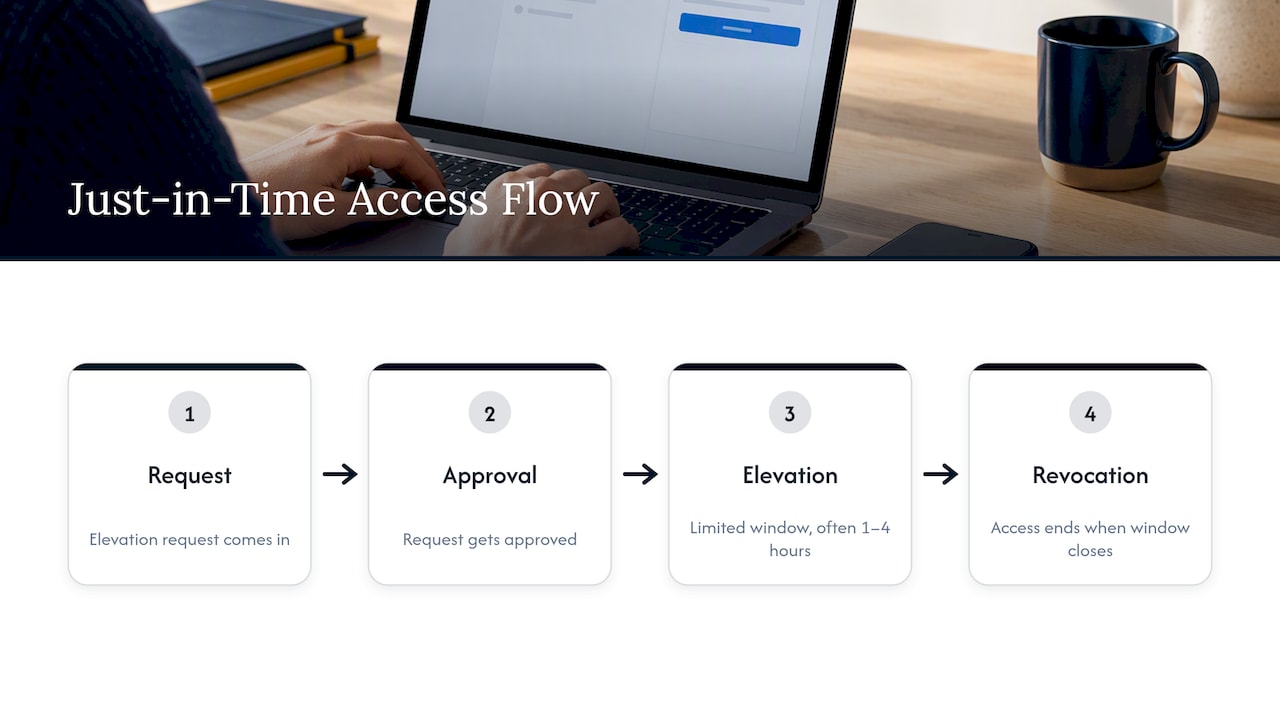
Just-in-time (JIT) access replaces standing admin rights with temporary windows. A request comes in, gets approved, the elevation activates for a limited period, often 1 to 4 hours, and access is automatically revoked when the window closes. This removes the permanent “always on” admin accounts that attackers love to find.
Privileged access management (PAM) platforms support JIT by adding session recording, audit trails, and approval workflows, so every elevated action is logged and reviewable rather than invisible.
Role-based access control (RBAC) works well when job functions are stable and permissions map cleanly to titles. Attribute-based access control (ABAC) fits better when access needs to flex with context, like department, device health, or time of day, since it supports more granular, context-aware scoping.
Permission boundaries and scoped tokens cap what a service identity or API key can do even if it’s compromised, which limits blast radius without requiring a human to intervene.
Pro Tip: Start your JIT pilot with the single admin domain your team requests elevation for most often. Quick wins build buy-in for a wider rollout.
Keeping permissions aligned over time
Governance is what keeps least privilege from decaying into privilege creep. A few processes do most of the work:
- Automate joiner-mover-leaver workflows by connecting your HR system to your identity platform so role changes trigger access updates automatically, not weeks later.
- Run periodic certification campaigns where managers attest that each direct report’s access still matches their current role.
- Use identity governance and administration (IGA) tooling to automate deprovisioning and flag stale entitlements before a human has to notice them manually.
- Document break-glass exceptions with built-in expiration dates and an audit trail, so emergency access never quietly becomes permanent access.
Skipping any one of these tends to produce the same result: permissions that reflect history rather than current need.
Technical controls across your environment
Enforcement looks different depending on where the access lives.
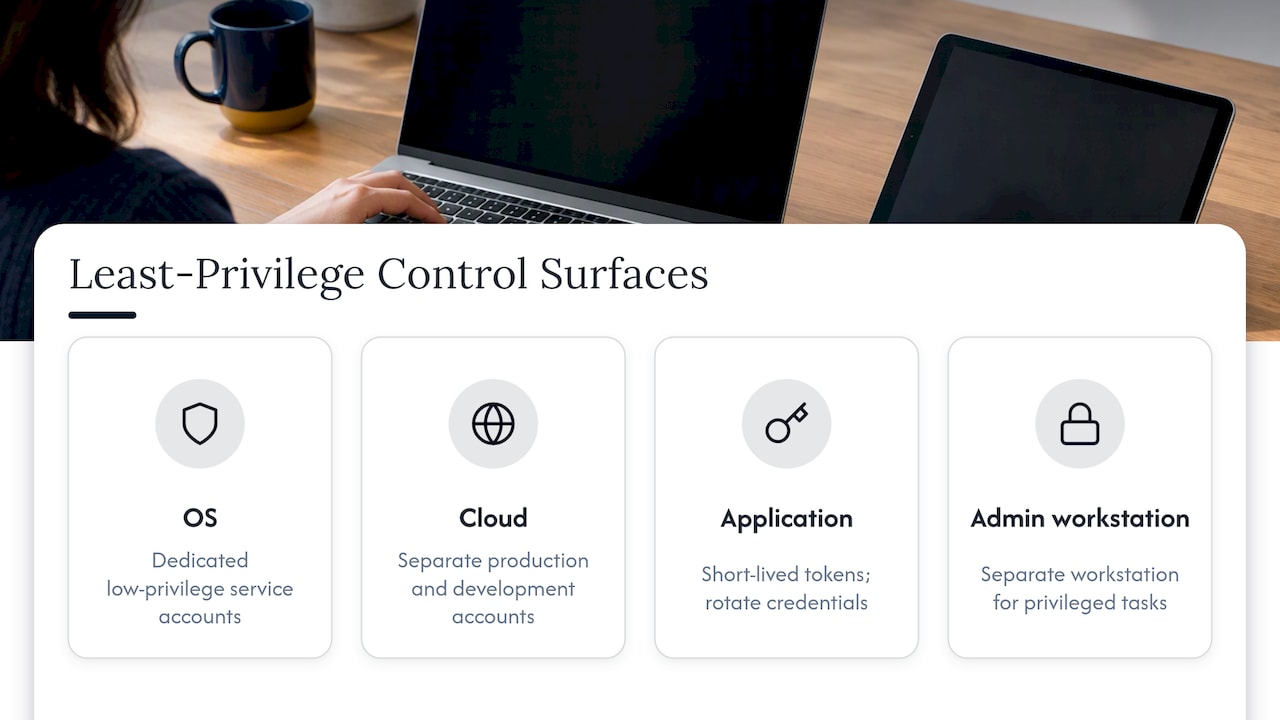
On the operating system level, services should run under dedicated low-privilege accounts rather than system or root, and platform-native controls like UAC, SELinux, or AppArmor help enforce that boundary automatically, a pattern IEEE’s guidance recommends across enterprise environments.
In cloud environments, separate your production and development accounts, assign scoped IAM roles instead of broad administrator policies, and use access analyzer tools to flag permissions that are granted but never used, consistent with the baseline expectations in NIST SP 800-53.
At the application layer, scope service accounts tightly, issue short-lived tokens instead of long-lived API keys, and rotate credentials on a fixed schedule rather than only after an incident. Our application whitelisting guide covers a related endpoint control worth pairing with these steps.
For admin tasks specifically, a dedicated privileged access workstation, physically or logically separated from everyday use, closes off a common path attackers use to reach high-value credentials.
Measuring whether least privilege is actually working
A policy on paper doesn’t tell you whether access is actually scoped correctly. Useful measurements include the share of granted permissions that go unused, how often privileged elevation is requested through JIT versus bypassed, and how quickly excess access gets remediated once flagged.
Automated access analyzer tools can identify permissions granted but never exercised, surfacing exactly the kind of dormant access that attackers exploit and that manual review tends to miss, a gap NIST’s control baseline for access control enforcement is designed to address.
Audit evidence matters just as much as the metrics themselves. Session recordings, attestation logs, and certification campaign results give you a defensible record when a regulator or auditor asks how access decisions get made and reviewed.
Common mistakes that undermine least privilege
Privilege creep is the most common failure mode: permissions accumulate through role changes, emergency grants, and default settings nobody revisits. The fix is a recurring certification cycle paired with automated deprovisioning, not a one-time cleanup.
Standing administrative access is a close second. Permanent admin rights sitting unused most of the time are exactly what attackers look for. Piloting JIT elevation in one admin domain, even before a full rollout, removes a meaningful chunk of that risk.
Over-broad service accounts round out the list. The fix is identifying an owner for every service identity, scoping its permissions to exactly what the task requires, and rotating credentials on a fixed schedule rather than leaving them static indefinitely. Our SMB access control guide walks through choosing the right model for these accounts.
How least privilege fits into zero trust and NIST frameworks
Zero trust architecture, as defined in NIST SP 800-207, evaluates every access request using context like identity, device health, and behavior rather than assuming trust based on network location. Least privilege is the enforcement layer underneath that: once a request is authorized, least privilege keeps the resulting access scoped to the minimum needed.
NIST’s practice guide on implementing zero trust shows how continuous, context-aware checks combine with commercially available tools across hybrid environments. Paired with the AC-6 control baseline in NIST SP 800-53, this gives SMB teams a concrete architecture and control set to align with, rather than an abstract principle to interpret on their own.
A phased checklist to enforce least privilege
Moving from policy to practice works best in phases rather than a single overhaul.
- Weeks 1 to 2: Inventory every privileged identity across your systems and flag obvious standing admin accounts that haven’t been reviewed recently.
- Next phase: Pilot just-in-time access for one admin domain, run your first certification campaign, and document what breaks or slows people down.
- Later phase: Roll out PAM more broadly, automate mover workflows tied to your HR system, and establish a recurring schedule for posture reviews.
Each phase produces something you can show an auditor or a board, which matters more than trying to fix everything simultaneously. A phased rollout also gives your team room to adjust approval workflows before they become company-wide policy. Our remote access policy template is a useful reference when documenting the joiner-mover-leaver piece of this plan.
Why ongoing governance matters more than a one-time fix
Small IT teams rarely have the headcount to review access manually on a regular basis, which is exactly why least privilege tends to decay fastest in SMB environments. A one-time cleanup feels productive, but permissions drift back within months without someone watching continuously. Sustained governance, not a single audit, is what keeps the posture intact. That’s where an operational partner earns its keep.
— Jeffrey
How we help you sustain least-privilege controls
Building a least-privilege program is one thing. Keeping it enforced every week, without a dedicated security team, is the part most small businesses struggle with. Our cybersecurity services include ongoing monitoring.

Our help desk is USA-based, so when a certification campaign flags an issue or a break-glass exception needs review, you can talk to our team. If you’d rather have a strategic hand guiding the rollout, our fractional IT leadership team can prioritize your phased plan and run it alongside your existing staff. Reach out for a discovery conversation and a prioritized remediation plan tailored to your current access posture.
FAQ
What is an example of a PAM tool?
Privileged access management (PAM) tools provide session recording, approval workflows, and time-bound credential vaulting for admin accounts. Our Privileged Access Management guide walks through how these capabilities work together in a typical SMB deployment.
What is the difference between zero trust and least privilege access?
Zero trust is a broader architecture that verifies every access request using context like identity, device health, and behavior before granting access, as defined in NIST SP 800-207. Least privilege is the principle that governs how much access gets granted once a request is authorized, keeping it scoped to the minimum necessary.
Can you provide an example of a least privilege policy?
A common policy pattern grants standard employees access only to the files and systems their specific role requires, while administrative rights are issued through just-in-time elevation for a limited window rather than standing permanently. Service accounts under this same policy would have narrowly scoped permissions tied to one task, with scheduled credential rotation.
What is the principle of least privilege in NIST SP 800-53?
NIST SP 800-53 lists least privilege as baseline control AC-6, requiring that users and processes be granted only the access necessary for their function, with enhancements covering privileged account logging and periodic review, according to the official publication. It also addresses preventing non-privileged processes from executing in elevated contexts.
How does the minimum necessary standard relate to least privilege?
The minimum necessary standard is a close parallel to least privilege, often applied specifically in regulated industries like healthcare to limit data access to what a role requires. Our partners at Minimum Necessary Standard audit guidance outline specific audit checks relevant to privacy officers managing this standard.