

Outsourcing IT commonly delivers predictable operating costs, specialist cybersecurity and cloud skills, and faster, more reliable operations for small and mid-sized businesses. The core tradeoffs are real too: you take on governance work, some dependency on a provider, and the risk of lock-in if contracts aren’t written carefully. For most SMBs weighing the decision, the benefits outweigh those risks when the provider relationship is managed well.
TL;DR:
- Outsourcing provides small and mid-sized businesses with scalable support, access to security expertise, and predictable costs, but requires careful contract management to avoid lock-in and governance issues.
- Building a total cost comparison must include internal hiring expenses, downtime risks, software tools, and transition costs to accurately evaluate outsourcing value.
- It enables access to enterprise-grade tools and licenses at a lower per-seat cost, leveraging volume purchasing and vendor partnerships instead of costly internal infrastructure.
- Risks such as provider security breaches, data lock-in, and unclear exit strategies can be mitigated by requiring detailed contracts, security posture assessments, and documented roles and responsibilities.
- Prioritizing outcome-based specifications, clear governance, and starting with pilot projects helps SMBs maximize outsourcing benefits while minimizing potential disruptions.
Table of Contents
- 1. Key Benefits at a Glance
- 2. How Outsourcing Changes Cost Structure and Cash Flow
- 3. Closing the Skills Gap: Expertise You Can’t Easily Hire
- 4. Scaling Capacity Without the Hiring Cycle
- 5. Measuring Operational Efficiency and Service Reliability
- 6. Access to Enterprise Technology Without the Enterprise Price Tag
- 7. The Honest Tradeoffs: Security, Lock-In, and Oversight
- 8. A Buying Checklist for Deciding and Evaluating Providers
- 9. Where Mavericks Office Solutions Fits This Picture
- 10. Compliance and Regulatory Adherence Benefits
- 11. What SMB Leaders Should Prioritize
- 12. Turning These Benefits Into a Plan With Mavericks
- Sources
- FAQ
1. Key Benefits at a Glance
Before going deep on any single benefit, it helps to see the full picture. These are the outcomes decision-makers report most often when they move IT support outside their own walls.
- Predictable operating costs: Monthly subscription pricing replaces unpredictable repair bills and surprise hardware failures.
- Specialist expertise on demand: Cybersecurity, cloud architecture, and compliance knowledge arrive without a hiring search.
- Scalability and flexible capacity: You add or reduce support as projects, seasons, or headcount change.
- Better uptime and faster delivery: Dedicated monitoring teams catch problems before they become outages.
- Lower capital spending: Hardware, licenses, and specialized tools get bundled into a service fee instead of a capital purchase.
- More focus for your internal team: Staff spend time on the work that grows the business instead of fixing printers.
Each of these benefits plays out differently depending on your industry, your existing tech stack, and how much risk you’re willing to hand to a partner. The sections below walk through what to measure and what to ask before you sign anything.
2. How Outsourcing Changes Cost Structure and Cash Flow
Most providers bill in one of three shapes: a flat monthly managed-services subscription, project-based fees for one-time work like a migration, or break-fix rates for ad hoc repairs. Subscriptions tend to suit businesses that want budget certainty, while break-fix suits a company with very light IT needs.
The bigger shift is moving spending from capital expenditure to operating expense. Instead of buying servers or building an internal help desk, you pay a recurring fee, which frees cash for a cash-constrained small business.
When comparing options, build a total-cost picture that includes:
- Salary, benefits, and training for an equivalent in-house hire.
- Downtime costs from slower incident response.
- Software and monitoring tools you’d otherwise buy separately.
- Transition costs for onboarding a new provider or team.
A simple way to compare two options: one with a lower sticker price but limited hours, and one with a higher flat fee but 24/7 monitoring, is to weigh the cost of unplanned downtime against the premium for always-on coverage.
3. Closing the Skills Gap: Expertise You Can’t Easily Hire
Finding and keeping cybersecurity talent is hard for any company, and small businesses compete against larger employers with deeper budgets. The 2025 ISC2 Cybersecurity Workforce Study found that 59% of respondents reported critical or significant skills needs, and 95% reported at least one skills gap on their team. That shortage shows up fastest at smaller companies without recruiting budgets to match.
Outsourcing gives you access to roles you likely can’t justify hiring full-time: a virtual CISO, a managed security services provider team, or a cloud architect who has handled dozens of migrations. NIST’s small-business guidance recommends defining your outcomes first and using role-level language from the NICE framework to describe exactly what skills you need, rather than shopping on price alone.
Before signing, ask for relevant case studies, confirm the specific roles assigned to your account, and check that responsibilities are documented in writing. Accountability for risk decisions still sits with your business, even when day-to-day work is delegated.
Pro Tip: Ask a prospective provider to map their team’s roles directly to the NICE framework categories relevant to your business before you compare pricing.
4. Scaling Capacity Without the Hiring Cycle
A provider’s biggest structural advantage is elasticity. You can add support for a holiday sales surge, a short-term software rollout, or a cloud migration, then scale back down once the project ends, without the cost or delay of hiring and later laying off staff.
Vendor ecosystems also speed up delivery. A provider that already has established relationships with cloud platforms, backup vendors, and security tool makers can usually implement a new system faster than a company building those relationships from scratch.
To keep flexibility from turning into scope creep, put these controls in the contract:
- Defined change-order rules for any work outside the original scope.
- Clear acceptance criteria for when a project or milestone is considered complete.
- A cap or review trigger for hours billed beyond the base agreement.
5. Measuring Operational Efficiency and Service Reliability
Most managed service providers handle the same core set of tasks: continuous monitoring, patch management, backups, and incident response. What separates a strong provider from a mediocre one is how those tasks are measured.
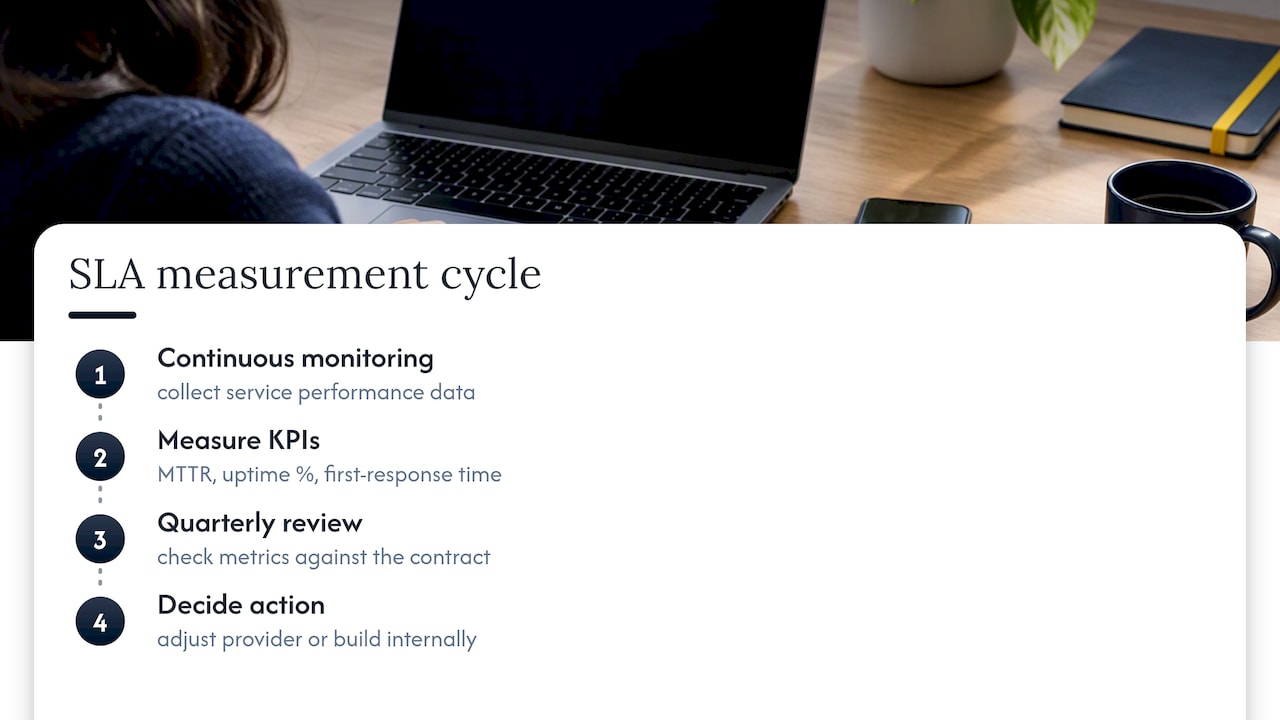
Service level agreements turn vague promises into numbers you can track. Reasonable KPIs include mean time to resolution, uptime percentage, and first-response time on tickets.
Among the small-business cybersecurity tactics tracked by ISC2’s 2025 workforce research, outsourcing and hiring third-party providers were both cited as common ways teams cope with skills shortages. That context matters when you’re deciding whether to build a security function internally or lean on a partner’s existing bench.
Set a quarterly review cadence with your provider to check these metrics against the contract, not just when something breaks.
6. Access to Enterprise Technology Without the Enterprise Price Tag
Providers buy licenses and tools in volume, which means a small business can access the same backup systems, endpoint detection and response platforms, and cloud credits that larger companies use, without paying for them individually.
- Enterprise-grade backup and endpoint detection and response tools, bundled into a monthly fee instead of a separate purchase.
- Vendor cloud credits and negotiated licensing that lower the per-seat cost of software like Microsoft 365.
- Centralized renewal management, so licenses don’t lapse or get forgotten across departments.
In-house ownership still makes sense for highly specialized systems tied to a narrow regulatory requirement, or where a proprietary tool has no managed equivalent. For most general IT and security needs, aggregated purchasing is hard to beat on cost.
7. The Honest Tradeoffs: Security, Lock-In, and Oversight
Handing IT to an outside team doesn’t remove risk, it changes its shape. NIST’s NCCoE project on MSP security notes that managed service providers have become attractive targets for attackers precisely because compromising one provider can expose many client networks at once. That’s a strong argument for requiring your provider to show its own security posture, not just promise to protect yours.
Vendor lock-in is the other common concern. Before signing, confirm:
- Data export terms: can you take your data and configurations with you if you leave?
- Transition assistance: will the provider help migrate to a new partner within a reasonable window?
- Incident response roles: who does what, and how fast, during a breach or outage?
- Audit rights: can you request logs or third-party security assessments?
A useful outside framing on this comes from a piece on hiring a partner instead of a vendor, which argues that the strongest outsourcing relationships are structured around shared accountability rather than a transactional purchase.
Pro Tip: Build a 30-day exit clause into every IT services contract, even if you never plan to use it.
8. A Buying Checklist for Deciding and Evaluating Providers
The GAO’s outsourcing framework identifies executive leadership, partner alignment, and relationship management as the critical success factors behind outsourcing decisions that work. Translated into a practical process, here’s how to move from considering outsourcing to signing a contract.
- Define the outcomes you need first: uptime targets, recovery time objectives, and response-time expectations.
- Shortlist providers based on relevant experience with businesses your size, not just brand recognition.
- Request quotes that map scope to deliverables, so you’re comparing what’s included, not only the monthly price.
- Check references from current clients in a similar industry or size range.
- Negotiate exit terms and data portability before you sign, not after a dispute starts.
- Run a short pilot, such as a single department or a 90-day trial, before committing company-wide.
- Set a recurring review cadence, quarterly at minimum, to confirm the provider is meeting agreed KPIs.
An outsourcing company that resists this level of documentation is telling you something about how the relationship will run once you’re a client.
9. Where Mavericks Office Solutions Fits This Picture
Mavericks Office Solutions operates as an outsourced IT department built around the benefits covered above. Its service lineup maps directly to the categories SMB leaders evaluate when outsourcing:
- Managed IT support with proactive monitoring, aimed at the uptime and efficiency benefits.
- Cybersecurity services addressing the expertise gap, including managed detection and response work.
- Cloud hosting, Microsoft 365, and UCaaS or VoIP for infrastructure and communications.
- Managed print services and vCIO or fractional IT leadership for executive-level technology strategy.
During procurement with any provider, ask for response-time logs and client references so you’re verifying these kinds of claims rather than taking them on faith.
10. Compliance and Regulatory Adherence Benefits
Regulatory requirements around data handling, breach notification, and recordkeeping change often, and keeping up with them is a full-time job on its own. A provider that already works across multiple clients in your industry tends to have more exposure to these requirements than a single internal IT generalist.
That exposure matters in two ways. First, providers often build compliance checkpoints, like regular vulnerability scans or access reviews, into their standard service rather than waiting for a reader to ask. Second, documentation becomes easier: a provider managing your systems can produce audit trails, patch histories, and backup logs on request, which are often what a regulator or insurer actually wants to see.
This isn’t a substitute for legal advice specific to your industry. A healthcare practice, a financial services firm, and a manufacturer face different rules, and no provider should claim blanket compliance coverage across all of them. What outsourcing does reliably offer is a partner whose daily work already touches the technical controls, like encryption, access logs, and backup retention, that most compliance frameworks require. Confirm with any provider exactly which regulations they have direct experience supporting before assuming coverage you haven’t verified.

11. What SMB Leaders Should Prioritize
Outsourcing IT is usually the right move once your internal team spends more time firefighting than building. Three priorities matter most: write outcomes-first specifications before you shop, keep clear governance over risk decisions even when operations are delegated, and start with a pilot instead of a company-wide rollout.
— Jeffrey
12. Turning These Benefits Into a Plan With Mavericks
Mavericks Office Solutions maps each benefit covered here to a specific service, so you’re not piecing together separate vendors for support, security, and communications.

- Managed IT Services deliver the predictable costs and measurable SLAs covered earlier, backed by that under-12-minute average help desk response.
- Cybersecurity closes the specialist skills gap without a dedicated internal security hire.
- Cloud Hosting and UCaaS / VoIP extend vendor access and infrastructure flexibility without large upfront purchases.
If you’re weighing outsourcing against building an internal team, a short discovery call is a low-friction way to compare scope and pricing before committing to either path. Reach out through Mavericksofficesolutions to start that conversation.
Sources
- 2025 ISC2 Cybersecurity Workforce Study (coverage and reporting)
- Building Your Small Business’ Cybersecurity Team: From In-House to Outsourcing | NIST
- GAO-02-214 Information Technology: Leading Commercial Practices for Outsourcing of Services
- Improving Cybersecurity of Managed Service Providers: Supporting Small-and Medium-Size Businesses
FAQ
What are the benefits of outsourcing?
Outsourcing typically delivers predictable costs, access to specialist skills you can’t easily hire in-house, and the ability to scale support up or down as needs change. It also frees internal staff to focus on work that directly grows the business rather than routine maintenance.
Is outsourcing a dying concept?
No, outsourcing remains a standard practice for IT, cybersecurity, and other specialized functions at small and mid-sized businesses. Demand has shifted toward providers who can prove measurable outcomes and strong security practices rather than disappearing altogether.
What is the main disadvantage of outsourcing?
The main risk is losing some direct control over day-to-day operations and becoming dependent on a provider’s performance and security posture. Clear contracts covering data portability, incident response roles, and exit terms reduce this risk significantly.
How much does it cost to outsource IT services?
Pricing varies by provider and scope, and Mavericks Office Solutions lists its Managed IT Services and Cybersecurity offerings without a published flat rate, meaning pricing is available on request. The right way to compare costs is to build a total-cost picture that includes salary, training, downtime, and tooling you’d otherwise pay for separately.