
Yes, security cameras are legal in Ohio, and video-only footage of your own property carries few restrictions. Audio recording is a different matter: Ohio’s wiretapping law requires one-party consent, and secretly recording someone in a bathroom, bedroom, or changing area can trigger criminal charges under the state’s voyeurism statute. Get the camera right, and you’re protected. Get the audio or the aim wrong, and you’re exposed.
TL;DR:
- Recording audio without all-party consent can lead to criminal charges, and most common mistakes relate to capturing conversations where no party has given permission.
- Cameras aimed directly at private spaces like windows into neighbors’ homes or inside rental units risk violating Ohio’s voyeurism laws and may result in misdemeanor or felony charges.
- Exterior cameras can usually be placed on your property without issues, but aiming them into public areas or private spaces increases legal risk and neighbor complaints.
- Disclosing or sharing footage without consent can result in criminal charges under Ohio’s laws against nonconsensual image dissemination, especially involving minors or sensitive content.
- Proper installation, with attention to privacy zones, audio settings, and documented policies, helps prevent most legal disputes and reduces criminal liability risks.
Table of Contents
- Video Vs. Audio: How Ohio’s Legal Framework Treats Surveillance Devices
- Key Ohio Statutes and Administrative Rules to Read
- Practical Placement Rules: Where You Can Aim Cameras and Where You Must Not
- Audio Recording Rules in Ohio: One-Party Consent and Common Traps
- Voyeurism, Minors, and Other Criminal Risks: Penalties and Examples
- Workplace, Rental Units, and HOA Rules: Context-Specific Guidance
- Handling Footage Requests, Police, and Evidence: A Short Procedures Checklist
- Operator Checklist and Installer Best Practices
- Author Perspective: Balancing Safety and Privacy in Ohio Deployments
- Compliant Camera Installs Backed by Local Ohio Support
- Sources
- FAQ
Video Vs. Audio: How Ohio’s Legal Framework Treats Surveillance Devices
Ohio has no single “security camera law.” Instead, coverage comes from a patchwork of statutes governing wiretapping, voyeurism, and privacy, plus scattered administrative rules for institutions like universities and hospitals. That patchwork treats video and audio very differently, and the distinction matters more than most homeowners realize.
Video-only systems face relatively light statutory restriction. Courts generally allow recording anywhere a person lacks a reasonable expectation of privacy, which covers most residential exteriors, driveways, and business entrances. Add a microphone, though, and you’ve stepped into wiretap territory governed by ORC 2933.52, which criminalizes intercepting oral communications without consent from at least one party to the conversation.
| Recording type | Governing law | Main restriction |
|---|---|---|
| Video only, exterior/public-facing | Common law privacy doctrine | No reasonable expectation of privacy required |
| Video only, private interior spaces | ORC 2907.08 (voyeurism) | Prohibited without consent in bathrooms, bedrooms, etc. |
| Audio capture, any location | ORC 2933.52 (wiretapping) | Requires one-party consent |
| Sharing recorded images | ORC 2917.211 | Nonconsensual dissemination is a crime |
Key Ohio Statutes and Administrative Rules to Read
Reading the actual statute text takes ten minutes and settles most disputes before they start. Here’s what governs camera use in Ohio, in plain terms:
- ORC 2933.52 — Ohio’s interception statute. It makes Ohio a one-party consent state for audio, but intercepting oral or electronic communications without any party’s consent is a fourth-degree felony, with civil damages available to the victim.
- ORC 2907.08 — the voyeurism statute. It bans surreptitious recording of people in places carrying a reasonable expectation of privacy, and penalties range from misdemeanor to felony depending on the victim’s age and the circumstances.
- ORC 2917.211 — criminalizes nonconsensual dissemination of intimate images, sometimes called revenge porn, with felony exposure attached.
- Rule 3337-44-119 and Rule 3344-76-01 — administrative rules that individual Ohio institutions use to govern surveillance on their own property, covering camera placement, access logs, and tamper protection.
These aren’t abstract legal footnotes. They’re the exact sections a prosecutor or a judge would pull up if a dispute over your camera ever escalated.
Practical Placement Rules: Where You Can Aim Cameras and Where You Must Not
Placement decides most disputes before audio or footage-sharing ever enters the picture. Point a camera at your own driveway, front door, or backyard, and you’re on solid ground almost every time.
Certain zones carry real legal risk regardless of your intent:
- Bathrooms, bedrooms, and changing areas, even your own, if a guest or renter could reasonably expect privacy there.
- Windows that look directly into a neighbor’s private living space, rather than incidentally catching their yard.
- Shared spaces like apartment hallways or laundry rooms, where recording may violate a lease or building policy.
- Any spot chosen specifically to capture a particular person’s private activity, which shifts the analysis from “incidental” to “deliberate.”
Catching a sliver of your neighbor’s yard because your driveway camera has a wide lens is generally fine. Aiming that same camera to track their windows, deck, or comings and goings is a different story, and it’s the fact pattern that generates most neighbor complaints reported to Ohio police departments.
Pro Tip: Walk your camera’s field of view at installation and physically mask or crop any private third-party windows using the camera app’s privacy zone feature. It takes five minutes and eliminates the single biggest source of neighbor disputes.
Audio Recording Rules in Ohio: One-Party Consent and Common Traps
Ohio’s one-party consent rule sounds simple, but it trips up more homeowners than any other part of Ohio security camera laws. Under ORC 2933.52, you can legally record a conversation you’re personally part of, like answering your own front door, without telling the other person. What you cannot do is capture a conversation between two other people who don’t know they’re being recorded and aren’t aware of your presence.
Situations where audio gets homeowners into trouble:
- Recording a conversation between a delivery driver and a neighbor that happens near your doorbell camera, where you’re not a participant.
- Placing a hidden recorder inside a rental unit to monitor tenants without their knowledge.
- Using a nanny cam’s audio feature to capture conversations among household staff or guests when you’re not present.
The penalty structure is not trivial: illegal interception under ORC 2933.52 is a fourth-degree felony, and the statute also opens the door to civil damages the recorded party can pursue separately from any criminal case.
Given that exposure, practitioners commonly recommend disabling audio at the hardware level unless you have a specific, documented reason to keep it on, since most commercial doorbell and security cameras ship with audio enabled by default.
Voyeurism, Minors, and Other Criminal Risks: Penalties and Examples
ORC 2907.08 covers surreptitious recording in places where someone has a reasonable expectation of privacy, and the fact patterns that trigger it are more common than you’d expect: a hidden camera in a guest bathroom, a device disguised as a clock in a rental bedroom, or a lens angled through a gap into a changing area.
- Base-level voyeurism violations are typically misdemeanors, but penalties escalate quickly.
- Recording a minor, or distributing footage of any victim, pushes the charge into felony territory.
- Sexual content or intent behind the recording is treated as an aggravating factor by prosecutors.
Sharing footage without consent adds a second layer of exposure. ORC 2917.211 criminalizes nonconsensual dissemination of intimate images separately from the original recording offense, meaning a single hidden camera can generate two distinct felony charges once the footage gets shared.
Workplace, Rental Units, and HOA Rules: Context-Specific Guidance
Employers, landlords, and homeowner associations each operate under a slightly different version of Ohio surveillance laws.
- Employers can generally monitor common work areas, entrances, and stockrooms, but should document a legitimate business justification and avoid break rooms, restrooms, or areas where employees change clothes.
- Landlords are usually fine installing exterior cameras covering shared entrances and parking, but interior cameras inside a tenant’s unit require either the tenant’s consent or explicit lease language.
- HOAs often layer additional restrictions on top of state law through architectural or design covenants, so check your association’s rules before mounting anything visible from the street.
Pro Tip: Get camera placement approved in writing by your HOA board before installation. Verbal approval from a single board member won’t protect you if a new board later objects.
Handling Footage Requests, Police, and Evidence: A Short Procedures Checklist
When police or a neighbor ask for your footage, how you respond matters as much as what the footage shows.
- Distinguish voluntary requests from legal demands. You can share footage voluntarily with police, but you’re not required to without a warrant or subpoena unless local ordinance says otherwise.
- Preserve the original file before making any copies, and note the date, time, and camera source to maintain a clean chain of custody.
- Call an attorney before releasing footage tied to a criminal investigation, a lawsuit, or anything involving a minor, since context can change how that footage gets used later.
Operator Checklist and Installer Best Practices
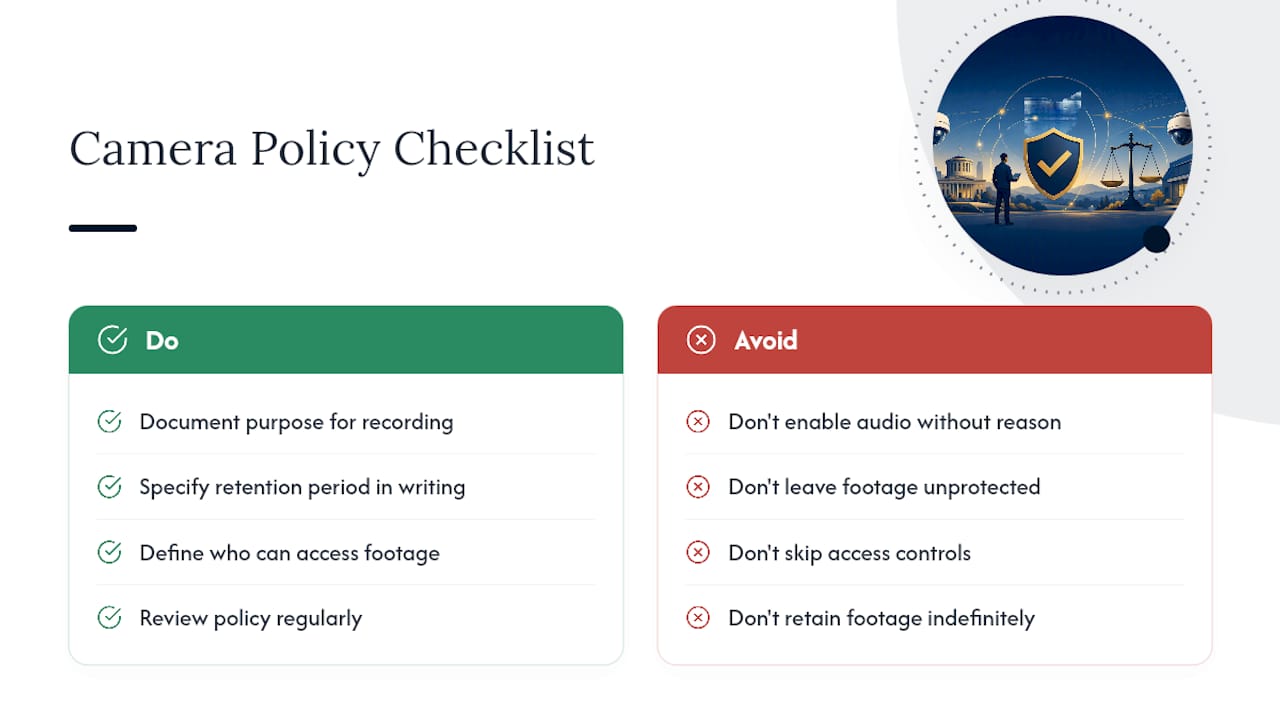
A written camera policy resolves most disputes before they become legal problems. Spell out your purpose for recording, how long footage is retained, who can access it, and how often you review it. Disable audio at the hardware level unless you have a documented reason to keep it active. Lock down footage storage with proper access controls, since unmonitored footage is itself a data breach risk if a device gets compromised.
Author Perspective: Balancing Safety and Privacy in Ohio Deployments
Most Ohio homeowners install cameras for a legitimate reason: package theft, car break-ins, or peace of mind about who’s at the door. The mistake I see repeatedly isn’t malice, it’s default settings. Audio ships on. Wide-angle lenses capture more than intended. Nobody reads the manual until there’s a dispute.
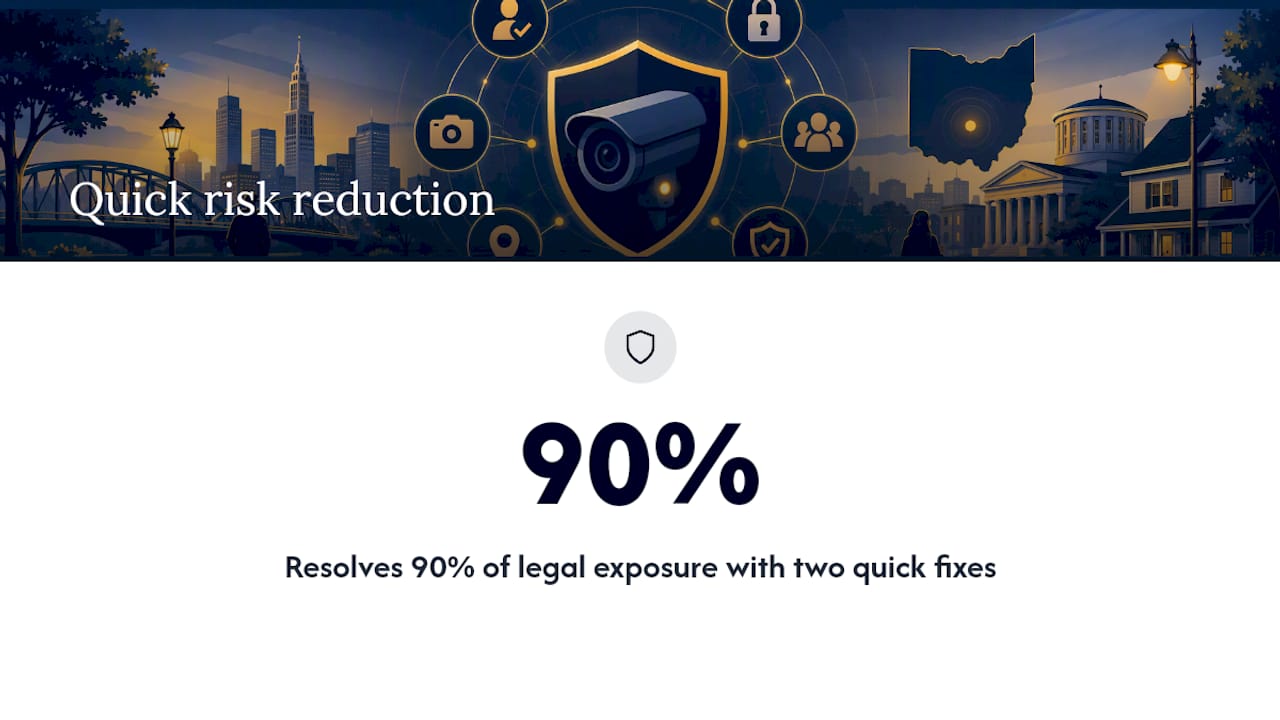
The fix isn’t fewer cameras. It’s fewer defaults left unchecked. A five-minute placement audit and one policy decision about audio will resolve 90 percent of the legal exposure discussed in this guide, and it costs you nothing but attention.
— Jeffrey
Compliant Camera Installs Backed by Local Ohio Support
Getting placement, audio settings, and retention policy right the first time saves you from the legal headaches this guide just walked through, and that’s exactly where a local partner earns its keep. Mavericks Office Solutions installs and manages Cameras & Access Control systems for Ohio homes and businesses, backed by a USA-based help desk with average response times under 12 minutes, not an offshore call queue that leaves you waiting when a camera goes down or a policy question comes up.

A first consult typically covers three things: a placement review to keep your field of view compliant, an audio configuration decision documented in writing, and a footage retention and access policy you can actually point to if a dispute arises. If your business also handles sensitive footage or customer data, pairing that installation with Cybersecurity monitoring closes the loop on storage risk. Reach out to Mavericks Office Solutions to schedule a placement and policy review before your next install.
Sources
Verify the primary law directly: ORC 2933.52 covers audio interception and one-party consent; ORC 2907.08 covers voyeurism; ORC 2917.211 covers nonconsensual image sharing; Rule 3337-44-119 and Rule 3344-76-01 illustrate institution-level surveillance rules. For plain-language summaries, see RecordingLaw’s Ohio guide.
This article is general information, not a substitute for advice from a qualified lawyer. Consult a qualified legal professional about your own circumstances before acting on anything here.
- Section 2933.52 – Ohio Revised Code | Ohio Laws
- Section 2907.08 – Ohio Revised Code | Ohio Laws
- Section 2917.211 – Ohio Revised Code | Ohio Laws
FAQ
Can a neighbor point a security camera at my house in Ohio?
Yes, if the camera incidentally captures your property while covering their own driveway, yard, or entrance. Deliberately aiming a camera to monitor your windows or private activities crosses into actionable territory.
Can I complain about a neighbor’s security camera?
You can raise the issue directly or contact local police if you believe the camera targets a private space like a bathroom or bedroom window, which falls under Ohio’s voyeurism statute.
Can I point my security camera at my neighbor’s property?
Only incidentally, as part of covering your own property. Deliberately focusing on a neighbor’s private windows or activities can expose you to a voyeurism claim under ORC 2907.08.
Is it legal to record audio on security cameras in Ohio?
Audio recording is legal only when at least one party to the conversation consents, per ORC 2933.52. Recording a conversation between two other people who don’t know you’re listening violates the statute.
Does Mavericks Office Solutions install security cameras that meet Ohio’s legal requirements?
Security companies offer Cameras & Access Control installation services for Ohio homes and businesses, which can include placement review and audio configuration guidance during setup.