

Vendor risk management (VRM) is the continuous program that identifies, assesses, and mitigates third-party risks so your organization retains defensible control over outsourced activities. If you need to act today, do three things: build a centralized vendor inventory, apply risk-based tiering to every relationship, and enroll your critical vendors in continuous monitoring. Here is a quick checklist to get started:
- Create your vendor inventory (Owner: Procurement or IT; due within 2 weeks; evidence: a spreadsheet or GRC record listing every active vendor, contract status, and data access level)
- Apply tiering criteria (Owner: Risk or InfoSec lead; due within 3 weeks; evidence: a written tiering policy with defined criteria for Tier 1, 2, and 3)
- Enroll critical vendors in monitoring (Owner: InfoSec; due within 30 days; evidence: at least one continuous monitoring feed active per Tier 1 vendor, with an alert threshold documented)
Table of Contents
- What is vendor risk management, and how does it differ from vendor management?
- What types of risk do your vendors actually create?
- How do you build a VRM program step by step?
- How do you assess vendor risk and build a defensible risk register?
- What should you monitor, and when does a vendor need reassessment?
- Who owns VRM, and how do you report it to leadership?
- What contract clauses actually reduce vendor risk?
- What capabilities should you look for in VRM tools and services?
- How long does a VRM program take to build, and what does it cost?
- What are the most common VRM pitfalls, and how do you avoid them?
- How Mavericksofficesolutions implements VRM for Michigan SMBs
- How do you onboard a new vendor with risk in mind?
- How do you exit a vendor without creating new risks?
- How do you train your team on VRM responsibilities?
- How do HIPAA, SOX, GDPR, and other regulations shape your VRM program?
- Key Takeaways
- What actually works when you run a VRM program
- Mavericksofficesolutions can run your VRM pilot for you
- Authoritative U.S. resources for VRM programs
What is vendor risk management, and how does it differ from vendor management?
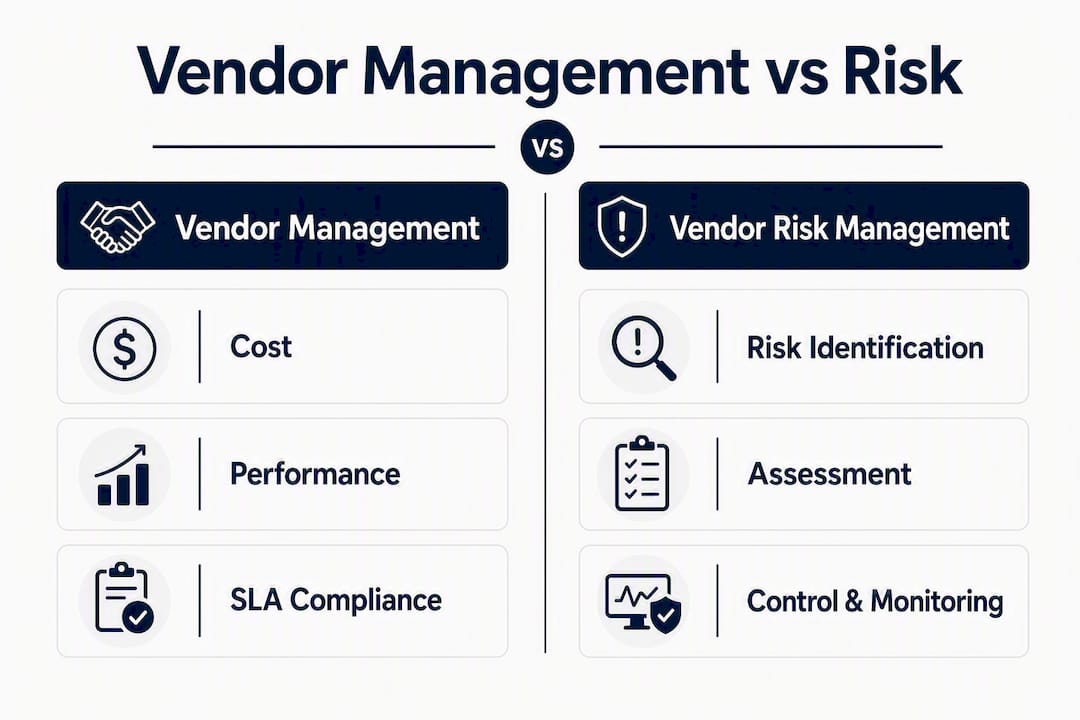
Vendor risk management is the governance discipline that identifies, evaluates, and controls the risks your organization inherits when it relies on third parties. It covers cybersecurity exposure, regulatory compliance, operational resilience, financial stability, and reputational harm. What it does not cover is the commercial side of the relationship: price negotiation, SLA performance credits, or contract renewals driven by cost. That is vendor management’s job.
The distinction matters because confusing the two leads to gaps. A procurement team focused on cost and delivery may never ask whether a SaaS vendor stores protected health information on unsecured servers. Regulatory frameworks now require documented vendor oversight and lifecycle management for critical third-party arrangements, and regulators expect organizations to share risk registers or evidence on request. Outsourcing a function does not transfer accountability for the risk it carries.
| Dimension | Vendor Management | Vendor Risk Management |
|---|---|---|
| Primary goal | Cost, performance, SLA adherence | Risk identification, mitigation, compliance |
| Typical owners | Procurement, operations | InfoSec, ERM, legal, compliance |
| Core outputs | Contracts, scorecards, renewal decisions | Risk register, assessment reports, decision records |
| How success is measured | On-time delivery, cost savings | Risk coverage, remediation closure rate, audit readiness |
What types of risk do your vendors actually create?
Every vendor relationship introduces at least one of five core risk domains. Understanding which domains apply to each vendor is the first step toward proportionate oversight.
- Cybersecurity risk: A SaaS vendor with access to your network or customer data can become the entry point for a breach. Under HIPAA and PCI DSS, your organization remains liable for that exposure even if the vendor caused it. Supply chain cybersecurity guidance from NIST SP 800-161 Rev. 1 specifically addresses how to manage risks from products and services that may contain vulnerabilities introduced during development or integration.
- Financial risk: A vendor that goes insolvent mid-contract can halt operations with no warning. For Michigan manufacturers relying on just-in-time suppliers, that scenario is not hypothetical.
- Operational risk: Logistics vendors, cloud providers, and utilities can all fail in ways that cascade into your own service delivery. Concentration risk, where too many critical functions depend on a single vendor, amplifies this exposure.
- Compliance risk: Vendors that handle personal data, financial records, or healthcare information bring SOX, HIPAA, GLBA, and state privacy law obligations into your environment. A vendor’s non-compliance becomes your audit finding.
- Reputational risk: A vendor publicly linked to a data breach, labor violation, or regulatory sanction can damage your brand by association, especially in B2B markets where trust is a purchase criterion.
Two cross-domain risks deserve special attention. Fourth-party risk (your vendor’s vendors, also called subprocessors or nth parties) is where many programs have blind spots. Supervisory guidance now expects organizations to map nth-party dependencies and manage concentration risk, with contract clauses that allow information access about subcontractors when relevant. Concentration risk is the second: if three of your most critical functions run through the same cloud provider, a single outage can trigger a multi-domain failure.
How do you build a VRM program step by step?
A mature program follows a consistent lifecycle. Each phase has a clear owner, a set of artifacts, and minimum evidence requirements.
-
Governance and planning. Define your risk appetite in writing, assign program ownership (typically ERM, InfoSec, or a combined function), and document escalation paths. Without executive sponsorship, the program stalls at the assessment phase. Centralized or federated governance models both work; what matters is consistency.
-
Vendor inventory. Catalog every active vendor, including SaaS subscriptions purchased outside IT. Record contract status, data access level, regulatory scope, and business owner. This is your program’s foundation.
-
Risk-based tiering. Assign each vendor to a tier using objective criteria: data sensitivity, system access, regulatory obligations, business criticality, and substitutability. Tier 1 vendors get the deepest scrutiny; Tier 3 vendors get lighter-touch reviews. Consistent tiering is what allows limited resources to focus on the highest-impact relationships.
-
Due diligence and assessment. Send a vendor security questionnaire (SIG Lite or CAIQ are standard starting points), collect evidence (SOC 2 Type II, ISO 27001 certificates, penetration test reports), score each domain, and produce a decision record: accept, mitigate, or reject.
-
Contracting. Translate assessment findings into contract obligations. Right-to-audit, incident notification timelines, data protection addenda, and subprocessor controls must be in the agreement before the vendor goes live.
-
Onboarding. Confirm that all contractual security requirements are met before granting system access. Assign an internal business owner and link the vendor record to your risk register.
-
Ongoing monitoring. Tier 1 vendors require at least annual reassessment, while lower tiers can be reviewed every 18–24 months or upon trigger events.
-
Incident response and offboarding. Define how a vendor-related incident escalates internally. When a relationship ends, revoke access, retrieve or destroy data per the contract, and document the transition in the risk register.
Tiering criteria at a glance
- Tier 1 (Critical): Processes regulated data, has privileged system access, is difficult to replace, or is subject to specific regulatory oversight
- Tier 2 (Significant): Has limited data access or moderate operational impact; substitutable within 90 days
- Tier 3 (Standard): No access to sensitive data, low operational impact, easily replaced
How do you assess vendor risk and build a defensible risk register?
A credible third party risk assessment produces a scored profile across five domains, a decision record, and a connected risk register. Use a 5-point scale (1 = negligible risk, 5 = critical risk) with a written justification for each domain score. That written justification is what makes the record defensible in an audit.
Acceptable evidence types
- SOC 2 Type II report: The gold standard for SaaS and cloud vendors; covers security, availability, and confidentiality controls over a period of time (not just a point-in-time snapshot)
- ISO 27001 certificate: Confirms a certified information security management system; check the certificate scope and expiry date
- Penetration test report: Require an executive summary and remediation status; a test older than 12 months carries limited assurance
- Audited financials or credit reports: For financial risk scoring; D&B or Experian business credit reports are practical for SMB-scale programs
- Insurance certificates: Minimum cyber liability and errors-and-omissions coverage; match limits to the vendor’s data access level
- Self-attestation: Acceptable only for Tier 3 vendors; never rely on self-attestation alone for a vendor with access to regulated data
Assessment scoring must include scope and tier, domain evidence, scored domains, decision rationale, and enrollment in continuous monitoring to be audit-defensible.
Sample risk register fields
| Field | Description |
|---|---|
| Vendor name and tier | Canonical name and assigned tier (1, 2, or 3) |
| Domain scores | Cyber, financial, operational, compliance, reputational (1–5 scale) |
| Composite risk score | Weighted average or highest-domain score |
| Decision | Accept / mitigate / reject with written rationale |
| Owner | Named internal business owner |
| Mitigations | Contractual and operational controls in place |
| Next review date | Based on tier cadence or trigger event |
| Evidence links | SOC 2, ISO cert, pen test, financials (with expiry dates) |

A risk matrix maps likelihood (1–5) against impact (1–5). Any vendor scoring 4 or 5 on both axes belongs in Tier 1 regardless of initial classification. Revisit the matrix whenever a vendor’s data access or system privileges change.
What should you monitor, and when does a vendor need reassessment?
A questionnaire at contract signature is a snapshot. The real program value comes from continuous monitoring and a dynamic risk register that reflects current conditions. Tier 1 vendors require at least annual reassessment, while lower tiers can be reviewed every 18–24 months or upon trigger events.
Recommended monitoring cadence
- Tier 1: Continuous monitoring feeds plus formal reassessment annually
- Tier 2: Semi-annual check-in on key evidence plus formal reassessment every 18 months
- Tier 3: Annual self-attestation review; formal reassessment every 24 months
Continuous monitoring feeds to ingest
- Security ratings platforms (they surface configuration drift, open vulnerabilities, and dark web exposure)
- Certificate expiration tracking for TLS/SSL and ISO/SOC 2 certificates
- Trust center and policy change alerts
- Public disclosures: SEC filings, press releases, regulatory actions, breach notifications
- Procurement and IAM system alerts for new vendor access grants
Triggers that require immediate reassessment
- Contract renewal or material scope change
- Vendor reports a data breach or security incident
- New data access or system privilege granted
- Addition of a subprocessor with access to your data
- Regulatory change that affects the vendor’s compliance obligations
- Significant financial event (acquisition, bankruptcy filing, leadership change)
Automation materially reduces manual effort and allows teams to prioritize high-risk vendors for detailed review. Connect monitoring alerts directly to the risk register so that a triggered event creates a task, not just an email.

Who owns VRM, and how do you report it to leadership?
Ownership confusion is one of the most common reasons VRM programs stall. Every function believes someone else is responsible, and critical vendors go unreviewed. A clear RACI resolves this.
Suggested RACI
- Procurement: Responsible for vendor inventory accuracy, contract clause inclusion, and onboarding gate checks
- InfoSec: Accountable for assessment methodology, scoring standards, continuous monitoring, and incident coordination
- Legal/Compliance: Consulted on regulatory requirements, DPA language, and right-to-audit enforceability
- Business owners: Responsible for identifying their vendors, providing context on criticality, and accepting residual risk within their domain
- Enterprise Risk Management (ERM): Accountable for program governance, risk appetite documentation, and board reporting
This maps to the three-lines model: business owners as the first line, InfoSec and compliance as the second, and internal audit as the third.
Executive KPIs worth reporting
- Percentage of Tier 1 vendors with a current (less than 12 months old) assessment on file
- Percentage of critical vendors enrolled in continuous monitoring
- Average remediation closure time for high-severity findings
- Number of vendors with expired SOC 2 or ISO certificates
- Concentration risk: percentage of critical functions dependent on a single vendor
Escalation criteria should be documented. A Tier 1 vendor scoring 4 or 5 on any domain goes to the CISO and business owner for a decision. A reject decision requires sign-off from the executive sponsor. Boards now expect documented risk appetite and regular third-party reporting, and having these escalation paths in writing is what makes a program board-ready.
What contract clauses actually reduce vendor risk?
Contracts are where risk findings become enforceable obligations. A vendor security questionnaire with no contractual follow-through is a compliance theater exercise.
Must-have contract clauses
- Right-to-audit: The right to audit the vendor’s security controls, either directly or through a third party, at least annually or upon a material incident
- Incident notification timing: Require notification within 72 hours of a confirmed breach (aligning with GDPR Article 33 and many state breach notification laws); 24 hours is achievable for Tier 1 vendors
- Data protection addendum (DPA): Defines data handling, retention, deletion, and sub-processing obligations; required for any vendor touching personal data
- Subprocessor controls and flow-downs: The vendor must apply equivalent protections to its own subprocessors and notify you before adding new ones
- Termination for cause and transition assistance: The right to terminate without penalty if the vendor fails a security audit or suffers a material breach, plus a defined transition period (typically 90 days) with data return or destruction
- Minimum insurance levels: Cyber liability (at least $1 million for most SMB contexts, higher for regulated data), errors and omissions, and general commercial liability
Matching clauses to vendor tier
Tier 1 vendors should provide contractual security artifacts: a current SOC 2 Type II report, ISO 27001 certificate (if applicable), and annual penetration test results. Tier 2 vendors should provide SOC 2 Type I or equivalent at minimum. Tier 3 vendors can rely on self-attestation with a right-to-audit clause as a backstop.
Pro Tip: When a vendor resists a right-to-audit clause, offer an alternative: accept a current SOC 2 Type II report in lieu of a direct audit. Most vendors will agree. If they refuse both, treat that as a red flag and document it in the risk register.
Negotiation tip: convert technical findings from the assessment into specific SLA obligations. If the assessment reveals the vendor lacks multi-factor authentication on admin accounts, the contract should require MFA implementation within 60 days with written confirmation. Vague “security best practices” language is unenforceable.
What capabilities should you look for in VRM tools and services?
The VRM market is substantial and growing, reflecting a wide availability of platforms and managed services to evaluate. The challenge is matching capabilities to your actual program maturity and staffing level.
Core platform capabilities checklist
- Centralized vendor inventory with tiering and ownership fields
- Workflowed assessments with questionnaire libraries (SIG Lite, CAIQ, custom)
- Evidence repository with expiry tracking for SOC 2 reports, ISO certificates, and pen tests
- Scoring engine that produces domain scores and composite risk scores
- Continuous monitoring integrations: security ratings, certificate monitoring, public disclosure feeds
- Reporting dashboards suitable for board and executive audiences
- API integrations with procurement systems and identity/access management (IAM) platforms
In-house platform vs. managed service
An in-house GRC platform gives you full control and is cost-effective at scale, but it requires dedicated staff to configure, maintain, and operate it. A managed VRM service delivers faster time to value, handles assessment orchestration, and provides expertise your team may not have in-house. For most Michigan SMBs, the staffing constraint is the deciding factor: if you do not have a dedicated risk analyst, a managed service will outperform a self-operated platform.
When evaluating any tool or service, prioritize audit defensibility and the ability to automate alerts into the risk register. A platform that produces beautiful dashboards but cannot generate a defensible decision record for an auditor is the wrong choice. Pilots matter: run a 60–90 day proof of concept on your top 10 Tier 1 vendors before committing to a full deployment.
How long does a VRM program take to build, and what does it cost?
Setting realistic expectations upfront prevents the program from being defunded after the first quarter.
Phased timeline
- Pilot (6–12 weeks): Scope 10–15 critical vendors, complete assessments, build the risk register, and identify the top 5 remediation items. Success looks like a documented risk register with decision records for every pilot vendor.
- Core rollout (3–6 months): Extend to all Tier 1 and Tier 2 vendors, implement continuous monitoring, and integrate with procurement and IAM. Success looks like full Tier 1 coverage and a live monitoring feed.
- Continuous operations (ongoing): Maintain cadence, close remediations, report to leadership quarterly, and update the risk register on trigger events.
Primary cost drivers
- Staffing: A dedicated risk analyst runs $70,000–$100,000 annually in most Michigan markets; a managed service typically costs a fraction of that for equivalent coverage
- Platform license: Entry-level GRC tools start around $15,000–$30,000 per year; enterprise platforms scale higher based on vendor count
- Integration work: Connecting a GRC platform to procurement and IAM systems typically requires 40–80 hours of IT effort
- Third-party assessment fees: External assessors for high-stakes vendors range from $5,000–$20,000 per engagement
- Continuous monitoring subscriptions: Security ratings and certificate monitoring services vary by vendor count and feed depth
For a budget-constrained SMB, start with a spreadsheet-based risk register, a free SIG Lite questionnaire, and one security ratings feed for your top 5 vendors. That costs almost nothing and gives you a defensible starting point. Invest in tooling once the process is proven.
What are the most common VRM pitfalls, and how do you avoid them?
Most programs do not fail because of bad intentions. They fail because of predictable, avoidable mistakes.
- Check-the-box questionnaires: Sending a questionnaire and filing the response without scoring it or linking it to a decision record produces no risk reduction. Require a scored domain assessment and a written decision for every vendor.
- Inconsistent tiering: Tiering that varies by assessor or business unit means your highest-risk vendors may never receive the scrutiny they need. Document tiering criteria and apply them uniformly.
- Disconnected risk register: A risk register that is not updated when monitoring alerts fire or when new vendors are onboarded becomes stale within weeks. Connect monitoring feeds to the register so updates are automatic or semi-automatic.
- Lack of executive sponsorship: Without a named executive owner, VRM competes with every other priority and loses. Secure a sponsor before the program launches.
- Shadow IT and unmanaged SaaS: Employees purchasing SaaS tools outside the procurement process create vendor relationships that never enter the VRM lifecycle. Use automated discovery tools and IAM integrations to surface them. This is one of the most common cybersecurity gaps in SMB environments.
Remediation playbook for a failing program
If your program has stalled, do these four things in order: (1) audit the vendor inventory for completeness, (2) re-tier every vendor using documented criteria, (3) identify the top 10 Tier 1 vendors with no current assessment and complete those first, and (4) present a one-page risk summary to your executive sponsor to re-establish accountability.
How Mavericksofficesolutions implements VRM for Michigan SMBs
For small and mid-sized businesses in Michigan, the challenge is not understanding what VRM requires. It is having the staff and tools to actually run it. Mavericksofficesolutions operates as an outsourced IT department, which means it can take on the operational work of a VRM program without requiring clients to hire dedicated risk staff.
A managed engagement with Mavericksofficesolutions typically covers:
- Vendor inventory and tiering: Building or auditing the client’s vendor list, applying consistent tiering criteria, and identifying Tier 1 vendors that need immediate attention
- Accelerated assessments: Completing vendor security questionnaires, collecting and reviewing evidence (SOC 2 reports, ISO certificates, pen test results), and producing scored assessment reports with decision records
- Continuous monitoring: Enrolling critical vendors in 24/7 monitoring feeds that alert on security rating changes, certificate expirations, and public disclosures
- Contract remediation: Identifying missing clauses (right-to-audit, incident notification, DPA) and supporting the client’s legal team in updating vendor agreements
- Incident coordination: With an average help desk response under 12 minutes and a local US-based team, Mavericksofficesolutions can act as the first point of contact when a vendor-related incident requires immediate triage
A 90-day pilot includes a scoped assessment of the client’s top 10 vendors, a remediation roadmap ranked by risk severity, and a live risk register with monitoring feeds active. At the end of 90 days, the client has a documented, audit-ready posture for their most critical vendor relationships. For organizations that need governance leadership without a full-time hire, fractional IT services can provide a part-time risk officer to own the program on an ongoing basis.
How do you onboard a new vendor with risk in mind?
Onboarding is the point where risk decisions become real. A vendor that passes a paper assessment but receives system access before contractual controls are confirmed is a gap waiting to become an incident.
The onboarding process should follow a defined gate structure. Before any access is granted, confirm that the vendor has signed the DPA and any required security addenda, that the assessment is complete and the decision record is documented, and that the vendor’s evidence (SOC 2, ISO cert, insurance certificate) is on file with expiry dates tracked. Assign an internal business owner at this stage, not after go-live.
Risk evaluation criteria at onboarding should include: the type and sensitivity of data the vendor will access, the systems and network segments they will connect to, the regulatory obligations triggered by the relationship, and whether the vendor has disclosed any subprocessors. For Tier 1 vendors, require a pre-access security review call with your InfoSec team. That conversation surfaces practical gaps that questionnaires miss.
How do you exit a vendor without creating new risks?
Vendor offboarding is where programs frequently cut corners, and the consequences can be serious. A former vendor that retains access to your systems or data after contract termination is a live security exposure.
Start planning the exit before the contract ends. A 90-day transition window is standard; for critical vendors, 180 days is more realistic. The transition plan should specify: who owns the data migration or destruction, which system access credentials need to be revoked and by when, what documentation the vendor must return, and how the client will verify that data has been deleted.
Operationally, the biggest risk during a vendor exit is service continuity. If the departing vendor runs a critical function, the replacement vendor must be onboarded and tested before the old relationship terminates. Overlap periods cost money but prevent operational gaps. Document the exit in the risk register, including the date access was revoked and the evidence of data destruction or return. Regulators and auditors may ask for this record.
How do you train your team on VRM responsibilities?
A VRM program is only as strong as the people running it. Business owners who do not know they are responsible for their vendors, or procurement staff who do not know which contract clauses to require, create gaps that no tool can close.
Training should be role-specific. Procurement staff need to understand tiering criteria, required contract clauses, and the onboarding gate process. Business owners need to know how to identify and escalate vendor-related risks and what their accountability looks like in the RACI. InfoSec staff need to understand assessment methodology, evidence standards, and how to operate monitoring feeds.
Annual training is a minimum. Supplement it with brief updates when the program changes (new tiering criteria, new regulatory requirements, new questionnaire standards). A short reference card summarizing each role’s VRM responsibilities, posted on the intranet or shared drive, reduces the volume of “who do I call?” questions significantly. For organizations using managed IT services, the managed service provider can deliver role-specific training as part of the engagement, keeping internal staff current without requiring a dedicated training budget.
How do HIPAA, SOX, GDPR, and other regulations shape your VRM program?
Regulatory requirements are not optional add-ons to VRM. For most U.S. organizations, they are the primary driver of program scope and documentation standards.
HIPAA: Covered entities and business associates must have a signed Business Associate Agreement (BAA) with every vendor that creates, receives, maintains, or transmits protected health information (PHI). The BAA is a contractual control, but it must be backed by a risk assessment. The HIPAA Security Rule requires a documented risk analysis, and vendor relationships are explicitly in scope.
SOX: Publicly traded companies must demonstrate that internal controls over financial reporting are effective. Vendors that process financial data or support financial systems are in scope for SOX IT general controls. Third-party assessments and right-to-audit clauses are standard audit expectations.
GDPR: For any vendor processing personal data of EU residents, a Data Processing Agreement (DPA) is legally required under Article 28. Subprocessor controls and the right to audit are also required. Michigan companies with EU customers or EU employee data are subject to GDPR regardless of their location.
State privacy laws: Michigan does not yet have a comprehensive consumer privacy law, but organizations doing business across state lines may be subject to California’s CPRA, Colorado’s CPA, or Virginia’s CDPA. Each requires vendor contracts to include data processing restrictions and audit rights.
NIST SP 800-161 Rev. 1 provides the most detailed U.S. government guidance on supply chain risk management, covering strategy, policy, and assessment practices across all levels of an organization. ISO 27001 and SOC 2 are the most widely accepted evidence standards for demonstrating vendor security controls to auditors and regulators.
Aligning your VRM program to these frameworks means mapping each regulatory requirement to a program control: HIPAA BAA to the contracting step, SOX IT controls to the assessment scope, GDPR DPA to the data protection addendum checklist. Document the mapping. When an auditor asks how your VRM program addresses HIPAA, you want a one-page answer, not a search through email archives.
This article is general information, not legal or compliance advice. Confirm current regulatory requirements with a qualified attorney or compliance professional for your specific situation.
Key Takeaways
A defensible vendor risk management program requires a live risk register, consistent tiering, continuous monitoring for critical vendors, and documented decision records that satisfy auditors and regulators.
| Point | Details |
|---|---|
| Start with inventory and tiering | Build a complete vendor list and apply objective tiering criteria within the first 3 weeks. |
| Assessments need decision records | Every vendor assessment must produce a scored profile and a written accept/mitigate/reject decision. |
| Tier 1 cadence is annual plus continuous | Tier 1 vendors require at least annual reassessment and continuous monitoring feeds active between reviews. |
| Contracts must enforce findings | Right-to-audit, incident notification, and DPA clauses are non-negotiable for vendors with access to regulated data. |
| Mavericksofficesolutions runs VRM pilots | A 90-day managed pilot covers vendor inventory, tiering, assessments, monitoring, and a remediation roadmap for Michigan SMBs. |
What actually works when you run a VRM program
Most VRM programs I have seen struggle not because the framework is wrong but because the risk register is treated as a filing cabinet rather than a live operational tool. The moment a vendor’s SOC 2 expires and nobody notices, the register has failed its purpose. Connecting monitoring alerts directly to register tasks, so that an expiry or a security rating drop creates an assigned action item, is the single change that most improves program reliability.
The second thing worth saying plainly: board-ready reporting is not about impressing executives. It is about creating accountability. When a CISO presents a one-page summary showing that 85% of Tier 1 vendors have current assessments and three have open high-severity findings, the board can ask a question and expect an answer. That dynamic changes how seriously the rest of the organization treats the program.
Shadow IT deserves more attention than most programs give it. Employees at Michigan SMBs routinely purchase SaaS tools on a credit card and never tell IT. Those vendors have access to company data, may be processing it in jurisdictions with different privacy laws, and have never been assessed. Automated discovery through IAM and procurement integrations is the only scalable answer. Manual discovery misses too much.
For teams building a program from scratch with limited resources, the first 90 days should focus on exactly three things: a complete vendor inventory, a scored assessment for every Tier 1 vendor, and a live monitoring feed for at least your top five. Everything else can wait. A narrow, well-executed program beats a broad, poorly maintained one every time.
Mavericksofficesolutions can run your VRM pilot for you
Running a vendor risk management program takes time, expertise, and tools that most Michigan SMBs do not have sitting idle. Mavericksofficesolutions gives you a fully operational VRM pilot in 90 days, without hiring a dedicated risk analyst or purchasing an enterprise GRC platform.
The pilot covers vendor inventory and tiering, scored assessments for your top 10 critical vendors, a live risk register with continuous monitoring feeds, and a prioritized remediation roadmap. You get a documented, audit-ready posture for your most important vendor relationships, backed by 24/7 cybersecurity monitoring and a local US-based help desk that responds in under 12 minutes on average. There are no offshore call centers and no vague deliverables. Just a clear scope, measurable outcomes, and a team that treats your risk program as its own. Contact Mavericksofficesolutions through the managed IT services page to schedule a scoped pilot conversation.
Authoritative U.S. resources for VRM programs
- NIST SP 800-161 Rev. 1: The primary U.S. government framework for cybersecurity supply chain risk management. Use it to map assessment controls, build C-SCRM strategy plans, and demonstrate governance to federal agency customers or auditors.
- BIS/BCBS Principles for Third-Party Risk: The international supervisory standard for financial-sector third-party risk. Use it to align your risk register structure, lifecycle management, and concentration risk reporting to regulator expectations.
- Gartner TPRM Guidance: Practical guidance on governance models, tiering, and program maturity. Use it to benchmark your program structure and build the business case for executive sponsorship.
- Fortune Business Insights VRM Market Data: Market sizing and growth context for VRM tools and services. Use it to justify tooling investment and understand the range of available solutions.
- University of Michigan IT Security Policy DS-20: A real-world example of a third-party vendor security and compliance policy from a major Michigan institution. Use it as a reference when drafting your own vendor security policy or onboarding requirements.